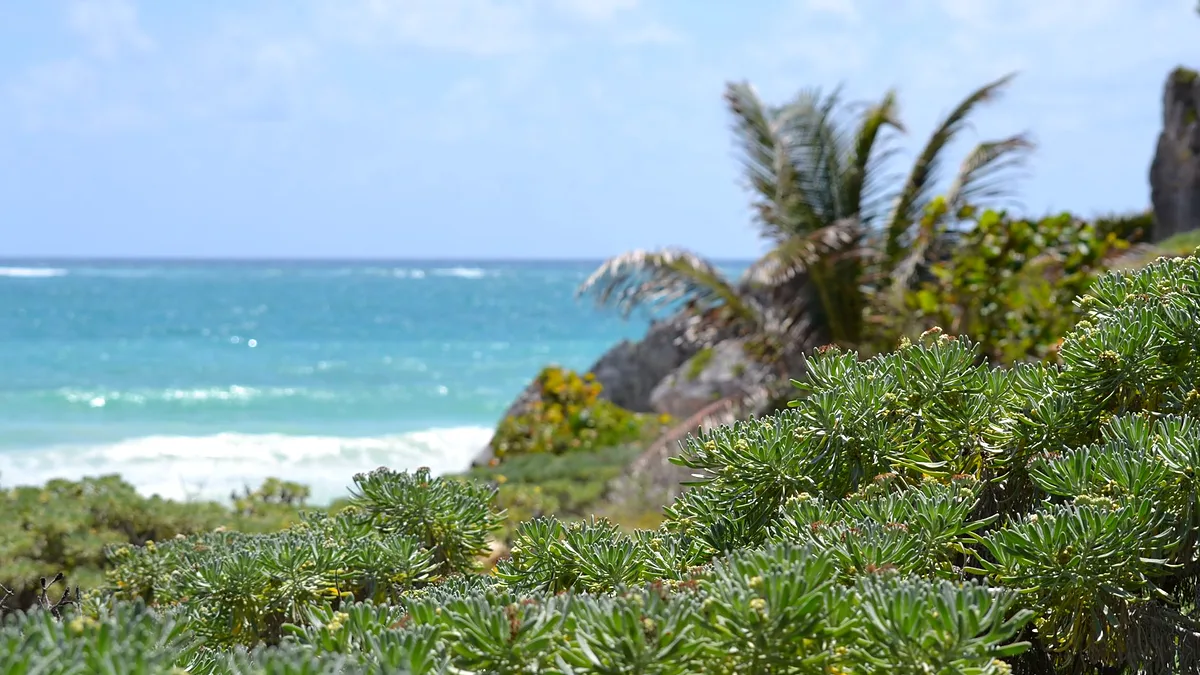

Tulum gets sold as a beach with a ruin attached. That is a shame, because the town, the cenotes west of the highway and the Maya villages to the south are where the actual trip is. This two-day route skips the $40 beach-club minimums and builds both days around archaeology, food and swimming holes you can reach without renting a car.
Expect a medium pace: two big mornings, two slow afternoons, and evenings back in the pueblo where dinner costs a third of what it does on the beach road. You will walk a lot, take a few short taxis, and eat very well.
- Duration: 2 full days (3 nights gives you breathing room)
- Best season: Late autumn — early November to mid-December, before Christmas rates hit
- Base: Tulum Pueblo, either Centro near Avenida Tulum or La Veleta a 10-minute walk south
- Transit: Colectivos, short taxis and a rented bicycle — no car needed
Day 1: Ruins Before the Heat, Pueblo After
Morning: The Tulum Ruins at 8 a.m. Sharp
Start with coffee and a pan dulce from any of the small cafés along Avenida Tulum near Parque Dos Aguas — budget 60–90 MXN (~$3–5 USD). Then grab a taxi from the centro to the archaeological zone, about 150 MXN (~$8 USD) for the 10-minute ride, or hop the colectivo that runs down the ruins road for a fraction of that.
Unlimited High-Speed International Travel eSIM
Connect in seconds across 180+ destinations. Instant QR code activation with zero roaming surcharges.

Be at the gate when it opens around 8:00. By 10:30 the tour buses arrive and the whole site turns into a queue. Entry is roughly 100 MXN (~$5.50 USD) plus a separate national park wristband of about 60 MXN, and both are cash-only more often than not. Guides at the entrance charge around 600–800 MXN for an hour — worth it if you want the astronomy and trade-route context, skippable if you have already read up.
Do not rush off when you finish the loop. Follow the wooden stairs down to the beach below El Castillo and swim. It is the same water the beach clubs charge for, with a better view.
Afternoon: Tacos, the Market and a Cenote
Head back to the centro for lunch at Antojitos La Chiapaneca on Avenida Tulum, where a plate of tacos al pastor with a drink lands around 150–200 MXN (~$8–11 USD). It is a plastic-chair, order-at-the-counter kind of place, and it is the best value meal in town.
Walk it off at the Mercado Municipal a few blocks away. This is where locals buy fruit, Yucatecan honey, hammocks and cheap sandals — bring small bills. The Casa de la Cultura nearby runs free or nearly free exhibitions and posts its schedule on the door; hours shift with the season, so check when you pass rather than planning around it.
At about 3:00 p.m., take a 10-minute taxi or cycle west to Cenote Calavera, the so-called Temple of Doom. Entry is around 250 MXN (~$14 USD), the water is cold and clear, and there are only three openings in the roof, so it never feels crowded. Bring a towel and reef-safe sunscreen — showers are mandatory before you get in.
Evening: Rooftop Light and a Proper Dinner
Here is the honest truth nobody puts in the brochures: Tulum's coast faces east, so you get sunrise over the sea, not sunset. The sun drops behind the jungle, which is why the good "sunset" is a rooftop in Aldea Zamá with a cold drink and a wide-open sky. Pick any terrace bar along the main avenue and pay 90–140 MXN (~$5–8 USD) for a beer or a mezcal.
For dinner, book or walk into Cetli on Avenida Tulum near Calle 2, a sit-down spot doing serious regional Mexican cooking — mains run 250–350 MXN (~$14–19 USD). Finish with a mezcal at one of the little bars on Avenida Tulum and walk home. The centro is well-lit and busy until about midnight.
Route Efficiency Tip: Day 1 is a straight line — centro to the ruins road, back to the centro, then west to the cenote. Never do the ruins in the afternoon and the cenote in the morning; you would cross the highway twice in the worst heat of the day for no reason.
Day 2: Muyil, Sian Ka'an Canals and a La Veleta Night
Morning: South to Muyil and the Jungle Canals
Eat breakfast in the pueblo — chilaquiles and coffee at a fonda near the market runs about 120–150 MXN (~$7–8 USD). Then walk to Avenida Tulum and flag a colectivo heading south on Highway 307 toward Felipe Carrillo Puerto. Ask the driver for Muyil; the ride is 20–25 minutes and costs roughly 50–70 MXN (~$3–4 USD).
The Muyil ruins are small, quiet and buried in jungle — a fraction of the crowd you met yesterday. Entry is about 50–75 MXN (~$3–4 USD), and an hour is plenty to climb the pyramid and look out over the lagoon system.
From there, walk or take a short transfer to the lagoon dock and join a boat tour into the Sian Ka'an Biosphere Reserve. Expect 1,200–1,600 MXN (~$65–87 USD) per person for the two-hour shared trip, cash preferred. The highlight is floating down an ancient Maya canal carved centuries ago, current-assisted, life jacket on. It is the single best thing to do near Tulum and almost nobody puts it on a two-day plan.
Afternoon: Ceviche and a Deliberate Siesta
Colectivo back to town and have a late lunch at El Camello Jr. on Avenida Tulum — tostadas and ceviche for 200–280 MXN (~$11–15 USD), and the portions are generous enough to split. Order the octopus tostada.
Then do nothing for two hours. Tulum's afternoon sun in November is still fierce, and every local disappears between 2:00 and 4:30 for a reason. If you want a beach fix, take a taxi to Playa Pescadores (about 200 MXN / ~$11 USD) rather than the hotel-zone clubs, or cycle the 8 km beach road if you rented a bike.
Swap option: if boats and jungles are not your thing, replace Muyil with Kaan Luum Lagoon, a shallow, sand-bottomed basin 10 km south with a deep cenote in the middle. Entry is around 300–400 MXN (~$16–22 USD) and there is nowhere to hide from the sun, so go early.
Evening: La Veleta, Mezcal and a Last Plate of Tacos
Wander south into La Veleta, the neighborhood behind the centro where the cafés and small kitchens have taken over. Grab a table at one of the courtyard restaurants on or near Calle 7 — dinner for two with drinks usually lands between 700 and 1,100 MXN (~$38–60 USD).
End the trip at a mezcalería. Ask what is from Oaxaca and what is local, sip slowly, and expect 120–180 MXN (~$7–10 USD) per pour for the good stuff. The walk back through La Veleta is quiet and flat, and street tacos are still sizzling until around 11:00 p.m. if you need one more.
Route Efficiency Tip: Everything on Day 2 sits south or east of the centro. Do not book a cenote tour that loops north toward Playa del Carmen — you will burn two hours in a van. Keep the day on the 307 corridor and finish on foot in La Veleta.
Getting Around Tulum
There is no metro and no ride-share worth relying on. The town runs on three things: colectivos, taxis and bicycles.
- Colectivos: Shared white vans leave from Avenida Tulum constantly for Playa del Carmen (around 45–60 MXN / ~$2.50–3.50 USD) and south toward Muyil and Felipe Carrillo Puerto. Flag them down, pay cash, tell the driver your stop.
- Taxis: No meters, ever. Agree the price before you get in. Centro to the beach road is 150–250 MXN (~$8–14 USD), centro to the ruins is about 150 MXN.
- Bikes: Rentals run 150–250 MXN (~$8–14 USD) per day in the centro. This is the best way to cover the flat beach road, but avoid cycling Highway 307 at night.
- ADO bus station: Sits right in the centro and connects to Cancún airport, Playa del Carmen and Valladolid. Book a day ahead in high season.
Walking in the centro is easy and safe, but sidewalks are uneven and there is almost no shade — carry water. Cash is still king at cenotes, market stalls and colectivos. ATMs in Tulum charge high fees and many restaurants add a 3–5% card surcharge, so pull out a few thousand pesos at a bank branch instead.
Estimated Daily Budget Breakdown
Figures are per person, per day, in Mexican pesos with rough USD equivalents at about 18.5 MXN to the dollar. Prices shift with the season and the exchange rate.
| Travel Style | Accommodation | Food & Drink | Transit & Sights | Total / Day |
|---|---|---|---|---|
| Budget Backpacker | 500–800 MXN (~$27–43) | 400–600 MXN (~$22–33) | 250–400 MXN (~$14–22) | 1,150–1,800 MXN (~$62–97) |
| Comfortable Mid-Range | 1,800–2,800 MXN (~$97–151) | 1,200–1,800 MXN (~$65–97) | 600–900 MXN (~$32–49) | 3,600–5,500 MXN (~$194–297) |
| Boutique Splurge | 6,000–11,000 MXN (~$324–594) | 3,000–4,500 MXN (~$162–243) | 1,500–2,500 MXN (~$81–135) | 10,500–18,000 MXN (~$567–972) |
Frequently Asked Questions
Do I need to book ruins and cenote tickets in advance?
The Tulum ruins and Muyil do not take online reservations — you pay at the gate and queue. The one thing worth booking ahead is the Sian Ka'an boat tour from Muyil, especially in late autumn when groups are smaller; a day's notice is usually enough, and your hotel can call. Skip any packaged "ruins plus cenote plus tequila tasting" tour sold on the street.
Can I do this itinerary without a car?
Yes, entirely. Day 1 is taxis and walking, Day 2 is two colectivos and a boat. Renting a car adds parking headaches in the centro and highway driving at night, plus mandatory Mexican insurance that can double the sticker price. Only rent one if you plan to add Cobá or Valladolid.
Where do I leave my luggage on the last day?
Most small hotels and hostels in the centro hold bags for free or for 50–100 MXN (~$3–5 USD) even after checkout — ask the night before. The ADO bus station also has paid lockers, though they fill up; get there before 10:00 a.m. on busy weekends.
Is late autumn actually a good time to visit?
It is one of the best windows of the year. November brings lower humidity, sargassum levels usually drop off, and hotel rates sit well below the Christmas and January peak. The trade-offs: a passing evening shower is common, some beach restaurants close for staff holidays, and Day of the Dead in early November fills the pueblo with Mexican families — book your room early if you land on those dates.