
Pokhara gets sold as the gateway to the Annapurnas, which is a bit like calling Paris the gateway to the airport. The town itself deserves three or four days: a lake you can row across for pocket change, cave temples cut into limestone, a Newari bazaar that predates tourism by a century, and a rice harvest in October that turns the whole valley gold.
Here is the part nobody puts on the poster. Doing all of it comfortably costs less than a mid-range hotel night back home. A lake-view room, a private boat at dawn, a hot thali and a taxi up a mountain can fit inside NPR 9,000 (roughly $68) a day, and often less.
At a Glance
Unlimited High-Speed International Travel eSIM
Connect in seconds across 180+ destinations. Instant QR code activation with zero roaming surcharges.

- Best time to visit: October to early December (clear peaks, rice harvest, festival season) or March to April (rhododendrons, warm days). Avoid June to August, when the mountains vanish behind cloud for weeks.
- Typical daily budget: NPR 5,500–9,000 (~$41–68) per person, covering a good guesthouse, three proper meals, local transport and one paid activity.
- Local transport: Walking in Lakeside, taxis or inDrive for everything else. Local buses from Prithvi Chowk cost NPR 20–80 (~$0.15–0.60).
- Vibe: Relaxed lake town with trekking-boot energy. Nobody is in a hurry, prices are negotiable, and the mountains do the dramatic work for free.
1. Row Yourself Across Phewa Lake at 6am
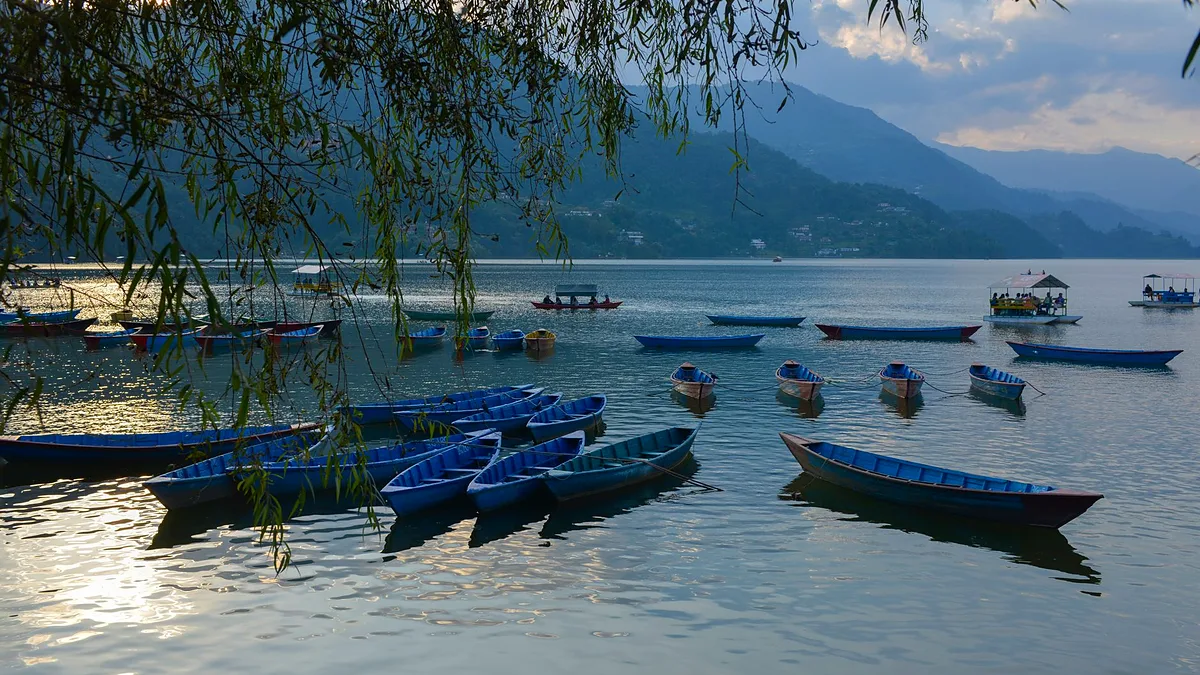
Phewa is four square kilometres of glass at dawn, with Machhapuchhre sitting upside down on the surface and nobody else on the water. By 10am the wind picks up, the paragliders start landing and the lake becomes a slightly choppy boat park. Go early and it feels private.
Skip the paddled boat and take a self-row one. You set the pace, you can drift under the trees on the far shore, and you reach the Tal Barahi island temple before the first tour group does. Life jackets are handed out at the pier, though the buckles are worth checking yourself.
- Neighborhood: Baidam / Lakeside, piers at Hallanchowk and Barahi Ghat
- Cost: NPR 400–600 per hour for a self-row boat (~$3–4.50). Paddler-guided boats run NPR 700–900 (~$5–7).
- Best time: 5:45–7:30am, October to April
- Getting there: Almost any Lakeside guesthouse is a 5–15 minute walk from a pier.
Insider tip: Ask to see the bailer before you pay, and stay inside the orange buoys on the northern side. Past them the lake gets shallow with submerged rice-paddy walls that will stop your boat dead.
2. Sunrise from Pumdikot, Not Sarangkot
Everyone tells you to do Sarangkot sunrise. Sarangkot is fine, but in season you will share the viewpoint with a few hundred people and forty idling jeeps. Pumdikot, twelve kilometres southwest on the same ridge, has a 108-foot Shiva statue, the identical wall of Annapurna peaks, and roughly a tenth of the crowd.
The statue is unmissable in the slightly bonkers way that giant roadside monuments usually are. Walk past it to the western edge and the entire Pokhara valley and Phewa Lake drop away below you. Bring a jacket, because it is cold and exposed up there before the sun clears the ridge.
- Neighborhood: Pumdikot ridge, above Chhorepatan, 30–35 minutes by road from Lakeside
- Cost: Entry NPR 100 (~$0.75). Shared taxi NPR 1,500–2,000 round trip (~$11–15). Local bus from Prithvi Chowk NPR 60–80 (~$0.45–0.60).
- Best time: Arrive 5:30am for a 6:15 sunrise. October to November and March to April are the clearest months.
- Getting there: Taxi or inDrive from Lakeside. Agree the return time and the full price before you set off.
Insider tip: Ask your driver to wait. There is no dependable transport back down until mid-morning, and the one shared jeep that does show up will be full.
3. Poke Around the Old Bazaar and Bindhyabasini Temple
Pokhara's old bazaar on the north bank of the Seti is not a tourist market. It is where people buy brass pots, sacks of millet, marigolds for the temple and school uniforms. The buildings are 19th-century Newari shophouses with carved wooden balconies, and almost nothing has been restored for visitors.
Bindhyabasini Temple sits at the top of the bazaar steps and is one of the oldest shrines in the valley, busy with locals from 5am. Photography of the inner sanctum is not permitted, and you will need to remove shoes and anything leather before entering. Give the whole loop, temple to bazaar to Bhimsen Temple, about ninety minutes.
- Neighborhood: Old Bazaar / Bagar, north of the Seti River
- Cost: Free. Temples accept donations, not entry fees.
- Best time: 7–10am for produce and puja crowds; 4–6pm for the light
- Getting there: NPR 250–350 taxi from Lakeside (~$2–2.70), or a local bus to Mahendra Pul plus a 10-minute walk
Insider tip: Buy your spices here rather than in Lakeside. The shops near the temple steps sell timur, garam masala and dried chillies at roughly half the price of the packaged jars down by the lake.
4. Gupteshwor Mahadev Cave and Davis Falls
The cave is a narrow, dripping limestone crack that drops forty-odd metres underground to a Shiva shrine and a viewing ledge behind Davis Falls. It is genuinely atmospheric: wet stairs, low ceilings, water running down the walls. It also costs less than a cappuccino in Lakeside.
It is not for everyone. The steps are steep and slick, the lighting is dim, and the bat guano smell is real. Wear shoes with grip and give it a miss if you are claustrophobic or pushing a stroller.
- Neighborhood: Chhorepatan, 10–15 minutes south of Lakeside
- Cost: NPR 100 (~$0.75) at Gupteshwor; Davis Falls entry is another NPR 100 (~$0.75)
- Best time: 8–10am, before the tour buses. Dry season only, since the cave floods.
- Getting there: NPR 300–400 taxi (~$2.30–3), or a 45-minute walk from Damside
Insider tip: The cave's lower chamber already looks up at Davis Falls, so if you are short on time you can reasonably skip the separate falls ticket and save NPR 100. Also, avoid the guides who offer to walk you down for NPR 500; it is a single staircase and you cannot get lost.
5. The World Peace Pagoda and the Ridge Walk Down
Built by Japanese monks in the 1970s, the white Shanti Stupa sits on a ridge on the far side of Phewa with a 180-degree view over the lake, the town and the Annapurnas. Entry is free and the grounds stay quiet, which is rare in a town where everything seems to have a ticket window.
The best version is this: boat across around 2:30pm, climb the stone steps through the forest for 45–60 minutes, watch the light at 4:30, then walk down the back way toward Damside through the rice terraces. You lose about 300 metres in an hour and land at a Lakeside restaurant in time for dinner.
- Neighborhood: Pamdi, on the far shore of Phewa above Chhorepatan
- Cost: Free. Boat across NPR 250–400 one way (~$2–3); taxi up NPR 800–1,200 (~$6–9).
- Best time: 3:30–5:30pm for softer light and thinner crowds
- Getting there: Rowboat from Barahi Ghat, or a taxi around the lake via Chhorepatan
Insider tip: Keep snacks and shiny things zipped away, because the monkeys along the steps are bold. And when walking down, take the stone staircase to the left of the main gate, not the vehicle road, or you will end up on a hairpin bend with no shade.
6. Begnas Lake and the October Harvest Fields
Twenty-five kilometres east of Pokhara, Begnas is what Phewa was thirty years ago: a quiet green lake with a small dam, a handful of tea shops and no boat touts. In October and November the fields around it are mid-harvest, golden rice cut and stooked, mustard going in behind. It might be the best free sight in Nepal.
Walk the ridge between Begnas and Rupa lakes in the morning, about three hours at a moderate pace, then eat dal bhat at a local bhojanalaya for the price of a bottled beer in town. It is a slow day, and that is the point.
- Neighborhood: Lekhnath municipality, Begnas Lake
- Cost: Local bus NPR 70–100 each way (~$0.50–0.75); boat hire NPR 500 per hour; dal bhat NPR 200–300 (~$1.50–2.30)
- Best time: Late September to November for harvest; arrive by 8am
- Getting there: Bus or micro from Prithvi Chowk, 45–60 minutes, or taxi NPR 1,800–2,200 (~$14–17)
Insider tip: Ask before photographing anyone working in the fields, and never walk into a paddy to get a better shot. A short guided walk through a Lekhnath community homestay runs about NPR 1,500 for a half day and puts the money straight into the village.
Where to Eat and Drink Nearby
Lakeside has more restaurants per metre than it needs, and quality swings wildly. These three are the ones locals and long-stayers keep going back to, all within a fifteen-minute walk of each other.
Lekali Kitchen
A proper Thakali kitchen with brass thali plates and black lentil dal that has clearly been simmering since morning. Order the Thakali set with buff sukuti and finish with curd. Expect NPR 450–650 (~$3.40–4.90) for a full set.
Moondance Restaurant
The old reliable on the Lakeside strip, running since the 1990s, with a garden that makes an NPR 600 dinner feel like an NPR 2,000 one. Wood-fired pizza and a decent Nepali set both work; mains run NPR 500–750 (~$3.80–5.60).
Pumpernickel Bakery
Breakfast institution with real espresso, brown bread and cinnamon rolls, plus a shaded courtyard away from the road. A coffee and pastry is NPR 350–500 (~$2.60–3.80), which makes it the cheapest way to feel like you are on a nicer holiday.
Practical Logistics and Budget Tips
Getting there
Pokhara International Airport (PKR) opened in 2023 but still has very few international routes, so most travellers fly Kathmandu to Pokhara in 25 minutes for NPR 4,000–7,000 (~$30–53). The tourist bus from Kathmandu costs NPR 1,200–1,800 (~$9–14) and takes six to seven hours on the Prithvi Highway.
Getting around
There is no meter culture. Agree the fare before you get in, or use inDrive and Pathao, both of which work in Pokhara. Walking is the real transport hack: Hallanchowk to Khahare along the lake road is about thirty minutes on flat ground.
Realistic costs
| What | Typical cost (NPR) | USD |
|---|---|---|
| Lake-view double room, mid-range | 3,500–6,000 | ~$26–45 |
| Thakali thali | 400–600 | ~$3–4.50 |
| Self-row boat, one hour | 400–600 | ~$3–4.50 |
| Taxi within Lakeside | 300–500 | ~$2.30–3.80 |
| Paragliding, booked directly | 8,000–9,500 | ~$60–71 |
| International Mountain Museum | 500 | ~$3.80 |
What to skip
- Hotel-desk paragliding packages. They add NPR 2,000–3,000 in commission. Walk into a Lakeside agency with a licence on the wall and book direct.
- Sarangkot sunrise jeep tours. NPR 2,500 for a crowded viewpoint you can reach by bus and a short walk.
- Zip-flyer and ultralight upsells. Fun, but they eat an entire day's budget in ninety seconds.
- Lakeside cultural dance dinners. Usually a buffet and a sound system. The real thing happens at Bindhyabasini during festival season, for free.
Honest heads-up: Phewa is not a swimming lake. The water carries runoff and the shoreline near Lakeside is not clean, so treat boats as transport and views, not swimming. Also carry cash: ATMs in Lakeside charge a flat NPR 500 fee and run out on weekends, so draw a few days of rupees at a time.
Rainy-day backup: The International Mountain Museum in Rani Pokhari is genuinely good on a wet morning (NPR 500 / ~$3.80, open 9am–5pm daily), and the Gurkha Memorial Museum nearby is another NPR 250.
Frequently Asked Questions
Is Pokhara expensive for tourists?
No. Pokhara is one of the cheapest destinations in South Asia at the mid-range level, and NPR 5,500–9,000 (~$41–68) a day buys a lake-view room, three good meals and an activity. The only real splurges are adventure sports like paragliding.
What is the best time to visit Pokhara on a budget?
October and November give you the clearest mountain views and the rice harvest, though prices peak around Dashain and Tihar. Late February to April is nearly as good, slightly cheaper, and warmer at night.
How many days do you need in Pokhara?
Three full days covers the lake, the caves, the old bazaar and one ridge day. Add two more if you want a trek or a Begnas Lake trip, and one rainy day as buffer.
Do I need cash in Pokhara?
Yes, for almost everything outside hotels. Boats, temples, buses, tea shops and taxis are cash only, so keep NPR 3,000–5,000 (~$22–38) on you and top up at a bank ATM rather than the standalone machines on the lake road.