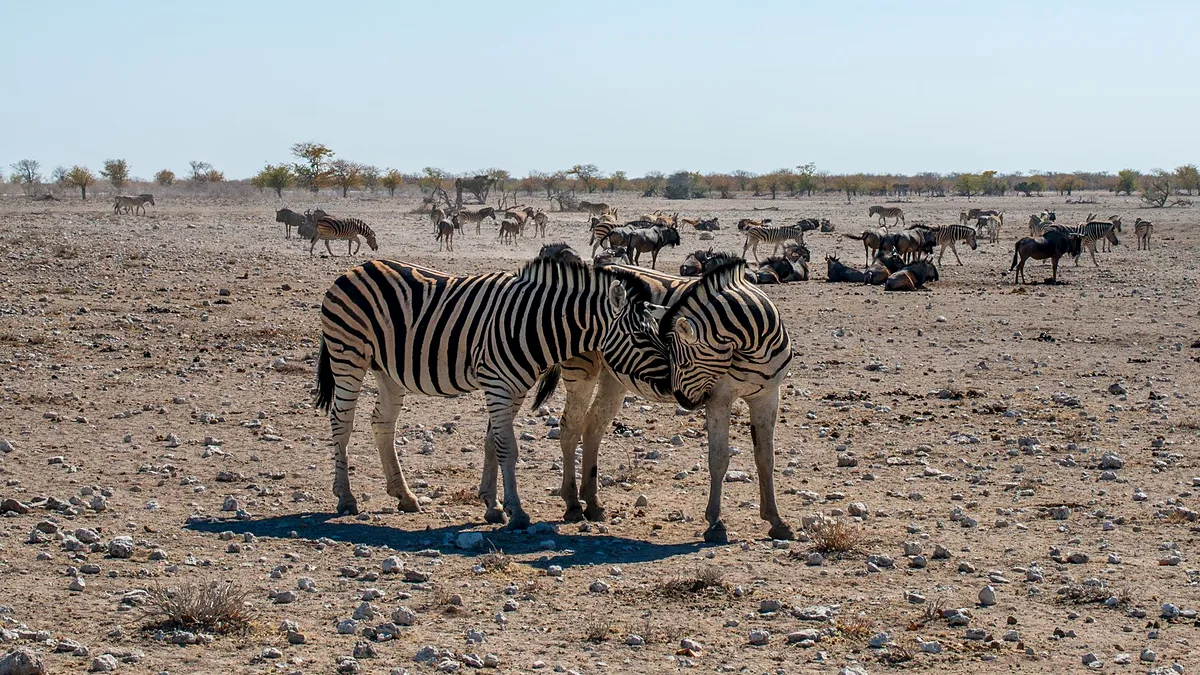

Etosha National Park is Namibia's flagship: 22,000 square kilometres of salt pan, mopane scrub and waterholes that pull in elephant, lion and black rhino. Most visitors come for that and drive straight back out without ever looking at the human story sitting just outside the park fence.
That story is smaller than you might expect, but it's real. There's a rebuilt German fort at Namutoni, a 60-tonne meteorite near Grootfontein, and roadside carvers shaping leadwood by hand on the drive up from Windhoek. You just need to know which stops are worth the fuel.
- Best time to visit: May to October (dry season) for wildlife and easier gravel roads. Craft stalls are busiest on weekday mornings.
- Typical daily budget: N$1,600–2,500 per person (~$85–135 USD) self-driving and camping; N$3,500–5,500 (~$190–300 USD) staying in park chalets or lodges.
- Getting around: your own car, full stop. There is no public transport inside the park and no shuttle between camps.
- Vibe: slow, dusty, self-reliant. You'll spend more time driving than browsing, so pick two or three heritage stops and skip the rest.
Namutoni Fort: The Rebuilt Outpost
Namutoni's whitewashed fort is the most photographed building in the park, and it's a replica. The original German police post went up in 1902–03, was attacked in January 1904 by forces loyal to King Nehale lya Mpingana, and burned. What stands today was rebuilt in 1957 from the original plans.
Unlimited High-Speed International Travel eSIM
Connect in seconds across 180+ destinations. Instant QR code activation with zero roaming surcharges.

The museum inside won't eat an afternoon. Twenty minutes is honest, but the exhibits on the 1904 battle and the old hand pumps are worth the stop, and the tower view across Fischer's Pan is the best free panorama in eastern Etosha. Time it for late afternoon, then come back for the floodlit waterhole after dinner.
- Location: Namutoni rest camp, eastern Etosha, reached via the C38 from Tsumeb
- Cost: included in park entry, roughly N$150–180 per adult per day (~$8–10 USD) plus N$50 (~$3 USD) per vehicle. Check the tariff board at the gate, fees move.
- Best time of day: 4–6 pm for the light, or after 7 pm for the lit waterhole
- How to get there: 105 km (about 2 hours) from Okaukuejo on internal gravel roads; 190 km from Tsumeb on tar and gravel
Insider tip: The fort is floodlit at night and the waterhole deck fills up fast after sunset. Bring a torch for the walk back and don't leave anything visible in your car at the day-visitor parking.
Okaukuejo's Stone Tower and the Research Station
Okaukuejo started life as a German military post in 1901, and the stone tower that went up with it is a declared national monument. It's fenced off and you can't climb it, so treat it as a five-minute look on your way to the shop rather than a destination in itself.
The real reason to stop here is the waterhole, which is the best night-time wildlife viewing in Namibia. Elephants, rhino and lion come in after dark under floodlights. The Etosha Ecological Institute sits behind the camp, and researchers occasionally give evening talks at reception. Ask when you check in, they're irregular.
- Location: Okaukuejo camp, central Etosha, 17 km north of Anderson Gate on the C38
- Cost: covered by your park entry fee; no separate charge
- Best time of day: 8 pm to midnight at the waterhole; the tower is a daytime stop only
- How to get there: self-drive, 430 km from Windhoek via Outjo, roughly 4.5 hours on good tar
Insider tip: Bring a headlamp with a red filter and a warm layer. The viewing area gets cold and windy after 9 pm, and white light spooks the animals and irritates everyone around you.
Okahandja Woodcarving Market: The One True Workshop
Two and a half hours north of Windhoek on the B1, Okahandja is where Namibia's woodcarving trade actually lives. Dozens of carvers work in the open air along the roadside, shaping kiaat, leadwood and makalani palm into bowls, salad servers, giraffes and roughly a thousand hippos.
Prices are negotiable and start low: around N$80 (~$4 USD) for a small bowl, N$350–700 (~$19–38 USD) for a decent large animal or serving platter, and N$900 (~$49 USD) upward for something substantial. It's the one stop on the drive where you can watch the work happening instead of buying a resale trinket stamped somewhere else.
- Location: Okahandja, on the B1 about 70 km north of Windhoek
- Cost: free to browse; budget N$200–500 (~$11–27 USD) if you actually want to buy
- Best time of day: 9 am to 3 pm on a weekday; many stalls shut on Sundays
- How to get there: a 2-hour drive from Windhoek, or the first leg of the 5-hour run to Etosha's Anderson Gate
Insider tip: Buy from the carver who is actually holding a chisel, not the one waving you down. Check the base of any bowl for hairline cracks from green wood, and always ask before taking photos. Some carvers expect N$20–30 (~$1–2 USD) for a portrait.
Tsumeb Museum and the Mineral Room
Tsumeb exists because of a copper mine, and that mine produced more than 240 mineral species, around 40 of which were first described here and nowhere else on earth. The town museum holds a genuinely good mineral cabinet alongside San arrowheads, Owambo baskets and German colonial photographs.
It's a proper small-town museum: dusty, idiosyncratic and staffed by someone who will happily talk you through the geology for half an hour. Give it 45 minutes, then walk the wide, quiet main street outside.
- Location: Tsumeb town centre, just off the B1, about 106 km from Namutoni
- Cost: around N$40 (~$2 USD) per adult
- Opening hours: weekdays roughly 9:00–12:30 and 14:00–17:00, Saturday mornings, closed Sunday
- How to get there: self-drive; Tsumeb is the park's main supply town for fuel, ATMs and groceries
Insider tip: Ask to see the second room, it's often locked and that's where the better pieces are. Buy mineral specimens from the museum shop rather than the roadside stalls, where the labels are frequently wrong.
The Hoba Meteorite: A Big Grey Rock Worth 40 Minutes
An hour west of Grootfontein, down a gravel road that turns to slop after heavy rain, sits the largest known single meteorite on Earth. About 60 tonnes of nickel-iron, flat as a pancake, still roughly where it landed some 80,000 years ago.
Namibia declared it a national monument in 1955. It is, frankly, a large rock in a field, but the scale is strange enough to stick with you, and the site has shade, benches and a very short interpretive trail. Set your expectations before you turn off the tar.
- Location: about 20 km west of Grootfontein on the D2859
- Cost: roughly N$50–100 (~$3–5 USD) per person
- Best time of day: early morning, before the gravel heats up and the tour buses arrive
- How to get there: 1 hour from Tsumeb, 2.5 hours from Namutoni if you're coming from inside the park
Insider tip: Pair it with fuel and groceries in Grootfontein so the drive earns its keep. Coming all this way for the meteorite alone is a hard sell for anyone who isn't mildly into geology.
Lake Otjikoto: The Sinkhole Full of German Guns
Twenty-four kilometres south of Tsumeb, right beside the B1, a limestone sinkhole drops dozens of metres into black water. In June 1915, retreating German troops dumped their artillery, ammunition and wagons into it rather than hand them over.
Some of it came back up. A field gun and a wagon sit under a shelter at the gate, and the lake itself is a technical dive site that requires a permit. As a stop, it's 20 minutes, but it's a strange and memorable 20 minutes.
- Location: beside the B1, 24 km south of Tsumeb toward Otavi
- Cost: about N$50 (~$3 USD) per person
- Best time of day: any time; it never takes long
- How to get there: a 15-minute drive from Tsumeb, easy on the way to or from the park
Insider tip: The curio stall at the gate is one of the better ones on this stretch for Owambo basket work, and the far side of the crater rim is the only shade for 40 km in either direction. Bring small notes.
Where to Eat and Drink Nearby
Outjo Bakery (Outjo, on the B1): The reason locals plan their fuel stops around Outjo. Pies run N$35–55 (~$2–3 USD), and the venison and pepper-steak versions sell out before 11 am. Open Monday to Friday from about 6:30, Saturday until midday, closed Sunday.
Kupferquelle Resort (Tsumeb): The town's most reliable sit-down meal, built around the old mine's spring. Mains N$130–200 (~$7–11 USD), cold draft beer, big lawn and a pool. Good for a proper dinner after a long park day.
Okaukuejo camp restaurant: Buffet dinner around N$300 (~$16 USD) per person, breakfast about N$180. It's functional rather than memorable, but after eight hours in the car that's fine. The camp shop's markup on water and beer is steep, so stock up in Outjo or Tsumeb first.
Practical Logistics and Money Tips
There is no public transport inside Etosha, no shuttle between camps and no way around having your own vehicle. A 2WD sedan is fine from May to October; if you're travelling November to April, a 4x4 makes the gravel roads far less stressful.
- Car rental: from about N$700 per day (~$38 USD) for a sedan in Windhoek, N$1,300 (~$70 USD) and up for a 4x4 with roof tent.
- Gate times: roughly 6:30–18:00 from April to September and 7:00–19:00 from October to March. You cannot drive after dark, so plan your last hour carefully.
- Fuel: available at Okaukuejo, Halali and Namutoni but noticeably pricier. Fill up in Outjo or Tsumeb.
- Cash: ATMs in Tsumeb and Outjo only. Carvers, Lake Otjikoto and the meteorite gate are cash-friendly and small notes go a long way.
- Realistic budget: N$1,600–2,500 per person per day (~$85–135 USD) self-driving and camping; N$3,500–5,500 (~$190–300 USD) for chalets and lodge meals.
What to skip: Lodge gift shops selling "handmade African" stock that was clearly made elsewhere, unlicensed "San village" tours hawked at fuel stations, and midday game drives when everything sensible is in the shade. If you want a real workshop circuit, add two days around Ondangwa and Oshakati to the north, where Owambo weavers work ekipa palm in open compounds.
Honest heads-up: Etosha's craft and heritage scene is small and spread out. Namutoni Fort is a nice 20 minutes, not a museum afternoon, and the meteorite is a rock. Come for the wildlife, treat the heritage stops as the seasoning, and you'll enjoy all of it far more.
Frequently Asked Questions
Are there craft markets inside Etosha National Park?
No. There are small curio shelves in the camp shops at Okaukuejo, Halali and Namutoni, but nothing you'd call a market. The real buying happens outside the park in Outjo, Tsumeb and Okahandja.
How much does it cost to visit Etosha's heritage sites?
Namutoni Fort and the Okaukuejo tower sit inside the park, so your daily conservation fee covers them. Lake Otjikoto and the Hoba Meteorite charge small separate entries of roughly N$50–100 (~$3–5 USD) per person.
Is the Hoba Meteorite worth the detour?
Only if you're curious about geology or you like odd roadside monuments. It's a 40-minute stop about an hour west of Grootfontein, so combine it with supplies in town rather than making a special trip.
What souvenirs should I buy near Etosha?
Hand-carved leadwood and kiaat pieces from Okahandja, Owambo basket work from roadside stalls near Tsumeb, and mineral specimens from the Tsumeb Museum shop. Buy from the person making it and carry small notes for easier bargaining.