
Hegra gets photographed from one angle: Qasr al-Farid, the lone tomb, standing against an empty sky. What that postcard leaves out is that this is a 111-tomb open-air sculpture park, and the interesting parts begin where the tour bus stops.
Two things surprise first-timers. Hegra isn't a museum you wander freely — you enter only with a licensed Rawi guide, so the good stuff is hidden in plain sight. And there is no private-club culture here in the Western sense. No bars, no velvet rope, no members-only door.
What AlUla does have is private access: rock-cut banquet halls the Nabataeans used for elite dinners, desert art commissions you reach by 4x4, and craft studios where you sit at the wheel yourself. Here's where to find them, what they cost, and what to skip.
Unlimited High-Speed International Travel eSIM
Connect in seconds across 180+ destinations. Instant QR code activation with zero roaming surcharges.

At a glance
- Best time to go: November to March, when days sit at 18–26°C. Book Hegra tours 1–2 weeks out; February fills up for the AlUla Arts Festival.
- Daily budget: SAR 350–650 (~$93–173 USD) per person, excluding your hotel. Add SAR 95–120 for the Hegra ticket.
- Getting around: No public buses reach Hegra. Rent a car (SAR 180–300/day) or book transfers — the site sits 25 km north of AlUla Old Town.
- Vibe: Quiet, desert-paced and guided. Sunrise starts, long lunches, stargazing. Not a nightlife destination.
Qasr al-Farid and the Tomb Circuit: Hegra's Open-Air Gallery
The Tomb of Lihyan, Son of Kuza — everyone calls it Qasr al-Farid, the solitary castle — is the one everybody came for. It's genuinely stunning, cut free of the rock on all four sides. But it's one of 111 monumental tombs, and 94 of those carry carved facades with pediments, eagles, sphinxes and funerary inscriptions that read like signatures.
The Nabataeans carved from the top down, which is why the details sit high on the rock and get missed by anyone staring at their phone screen. Walk the Jibal al-Banat cluster slowly. That's where the sharpest reliefs are.
- Where: Hegra Archaeological Site, 25 km north of AlUla Old Town.
- Cost: SAR 95–120 (~$25–32 USD) per adult for the guided tour. Premium vintage Land Rover tours run SAR 350–600.
- Best time: The first departure around 7:30am for cool air and empty frames, or the 3pm slot for raking light on the facades.
- Getting there: Book through Experience AlUla. Shuttles leave from Winter Park in AlUla; you can also drive to the Hegra Welcome Centre.
Insider tip: Most groups sprint to Qasr al-Farid for the photo, then sit on the bus. Ask your Rawi to walk you past the small tombs on the site's northern edge — the lion and eagle carvings there are crisper than anything on the famous one, and nobody is standing in front of them.
The Diwan at Jabal Ithlib: Hegra's Original Private Club
Jabal Ithlib is a sacred outcrop you reach through a narrow siq, and at the end of it sits the closest thing this site has to a members' lounge. The Diwan is a rock-cut chamber roughly 12 metres wide with benches carved along three sides — scholars believe it hosted ritual banquets and council meetings for the Nabataean elite.
It's a room for the invited, cut into stone, with niches for the gods set into the walls at shoulder height. Nearby you'll find the Sacred Hall and a sunken courtyard. Standing in the shade here, with the temperature dropping ten degrees, you get why they picked this spot.
- Where: Northeast of the main tomb field, inside the Hegra boundary.
- Cost: Included with your Hegra ticket (SAR 95–120 / ~$25–32 USD).
- Best time: Late afternoon — the siq falls into shade by about 4pm.
- Getting there: Guided shuttle only; walking the site unaccompanied isn't permitted.
Insider tip: Look for the tiny betyl niches carved into the siq walls on your way in. Tour groups walk straight past them, and they're the reason the place was considered sacred long before the tombs went up.
Wadi AlFann and Desert X AlUla: Land Art You Walk Into
Desert X AlUla brought monumental temporary commissions into the canyons next to Hegra, and it's free. The 2024 edition was staged at Wadi AlFann — the long-term land-art valley being built beside the heritage site, with permanent works from artists including James Turrell, Michael Heizer and Manal AlDowayan arriving in phases.
This is not a gallery you stroll through in twenty minutes. Pieces are sited kilometres apart on ledges and canyon floors, and finding them is half the experience.
- Where: Wadi AlFann, adjoining the Hegra site; access points shift with each edition.
- Cost: Free. Some editions require a free timed booking.
- Best time: 3–6pm, when the sandstone turns copper.
- Getting there: Shuttle from AlUla Old Town or your own car. Signage is minimal — download the Experience AlUla map before you lose signal.
Insider tip: Carry two litres of water per person and wear closed shoes. The ground between installations is loose rock, and there's no shade and no phone reception out there.
Madrasat Addeera: The Working Studio in AlJadidah
Madrasat Addeera is a restored girls' school in the AlJadidah arts district, now the craft heart of AlUla. Inside you'll find pottery wheels, palm-frond weaving, jewellery benches and textile looms, worked by resident artists from AlUla and further afield. Finished pieces are for sale at prices far below the hotel gift shops.
It's the best place in town to understand what local craft actually looks like when it's alive rather than displayed behind glass. The AlUla Arts Festival in February turns the whole district into an open studio trail.
- Where: AlJadidah Arts District, a 10-minute walk from the AlUla Old Town car park.
- Cost: Free to enter. Workshops run SAR 80–300 (~$21–80 USD).
- Best time: Late morning to mid-afternoon, when the studios are actually working.
- Getting there: Walk from Old Town or take a five-minute taxi.
Insider tip: Pick the two-hour palm-weaving session over pottery. What you make packs flat and survives a suitcase.
Ashar Valley: Maraya, Banyan Tree and the Club Question
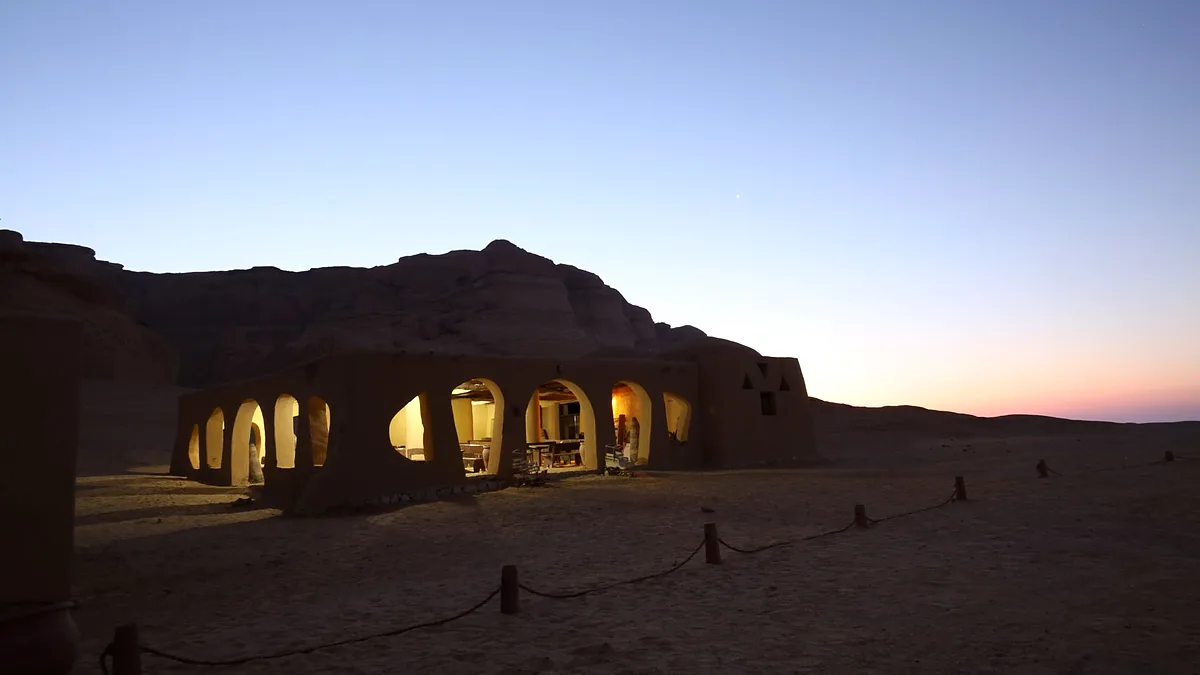
Maraya holds the Guinness record for the world's largest mirrored building — nearly 10,000 square metres of glass that turns the surrounding cliffs into the exhibit. It's a concert hall most nights and a sculpture most days. Twenty minutes away, the Banyan Tree and Habitas resorts have the nearest thing AlUla offers to a clubhouse: fire pits, tented lounges and long desert views.
Be clear about what this is. There are no members' clubs, no bars and no nightlife in AlUla — alcohol is prohibited across Saudi Arabia. The scene here is dinner, a terrace and stars. If the Chedi Hegra has opened by the time you read this, it's built around the old Hijaz Railway station inside the heritage site itself.
- Where: Ashar Valley, roughly 25–30 km from AlUla Old Town.
- Cost: Maraya tours around SAR 60 (~$16 USD), free with a concert ticket. Dinner at the resorts runs SAR 250–450 (~$67–120 USD) per person.
- Best time: Sunset, when the mirrors catch fire and the valley cools down.
- Getting there: Drive or pre-book a transfer — there's no taxi rank out there and ride-hailing is unreliable.
Insider tip: You don't need a room key. Call ahead to book dinner at the Banyan Tree and ask whether you can stay for the terrace afterwards. Most people don't ask, and most places say yes.
Hegra After Dark: Lanterns and Stargazing
AlUla is a dark-sky zone, and past seasons have run night sessions where you walk the tomb field with lanterns and a guide before finishing under a sky that looks exaggerated. This is when the site feels least like an attraction and most like a place people once actually buried their dead.
Availability is seasonal, so check the current Experience AlUla calendar before you build a trip around it. Dawn hot-air balloon flights over the tombs are the other splurge, and they're spectacular but pricey.
- Where: Hegra site and the stargazing sites around Gharameel.
- Cost: Night tours SAR 150–250 (~$40–67 USD). Balloon flights start around SAR 1,200.
- Best time: Winter, on a moonless night, with a jacket — desert nights drop fast.
- Getting there: Shuttle from Winter Park, same as the daytime tour.
Insider tip: If you only have budget for one premium add-on, take the night tour over the balloon. You see more, learn more, and don't spend ninety minutes freezing in a basket.
Where to Eat and Drink Nearby
Pink Camel Pastry Boutique (AlJadidah) — A small, cheerful café that opens early enough for the first Hegra departure. A flat white runs SAR 20 (~$5 USD) and a cardamom bun SAR 24. Sit outside; the district is empty before 9am.
Somewhere (AlJadidah) — Mediterranean-leaning plates with a rooftop that's worth booking for sunset. Mains sit at SAR 55–95 (~$15–25 USD); the grilled chicken and fattoush are reliable. Service slows when the festival crowds arrive.
Kabsa kitchens on King Fahd Road, AlUla town — No frills, plastic chairs, families and site workers. A full chicken kabsa with rice and salad lands at SAR 25–45 (~$7–12 USD) and feeds two easily. This is the best value food in AlUla, full stop.
Practical Logistics and Budget Tips
Book Hegra first and build the rest of your trip around it. Tickets are limited, guided slots sell out in peak season, and everything else — galleries, studios, valley dinners — can be arranged around whatever time you land.
- Rent a car. Fuel is about SAR 2.33 a litre, petrol stations are everywhere, and a rental costs less than two taxi round-trips to Ashar Valley. Parking at Winter Park is free.
- Carry some cash. Cards work nearly everywhere, but keep SAR 100–200 on you for roadside kiosks and small studios. Tip around 10%.
- Dress for the desert. Shoulders and knees covered; a light scarf handles wind, sun and sudden air conditioning.
- Skip the venue afternoon teas at SAR 180+ per person — they're pleasant but forgettable. Skip camel rides at Elephant Rock too; it's a car-park photo stop, not an experience.
- Never accept a 'Hegra without a guide' offer. It's not permitted, and the people offering it don't have access either.
- No drones. They're confiscated at the airport and at site entrances.
- Avoid midday tours in summer. June to September regularly hits 40°C+ and schedules get cut back.
Frequently Asked Questions
Can you visit Hegra without a guide?
No. Hegra is a protected UNESCO World Heritage Site and entry is only permitted with a licensed Rawi guide booked through Experience AlUla. Tickets are limited per day, so book one to two weeks ahead in winter.
Are there any bars or private clubs in AlUla?
There are none. Alcohol is prohibited throughout Saudi Arabia, so the closest thing to a club scene is the terrace and lounge at resorts like the Banyan Tree and Habitas in Ashar Valley. Book dinner and you can generally use the lounges afterwards.
How far is Hegra from AlUla Old Town?
It's about 25 km north, a 25–30 minute drive. Most visitors join a shuttle from Winter Park in AlUla rather than driving themselves, and no public bus route serves the site.
When is the best time to see Desert X AlUla and Wadi AlFann?
Desert X AlUla is a biennial, with the most recent edition staged at Wadi AlFann, so check Experience AlUla for the next dates. The AlUla Arts Festival in February is the single best week to see studios, galleries and new commissions open at the same time.