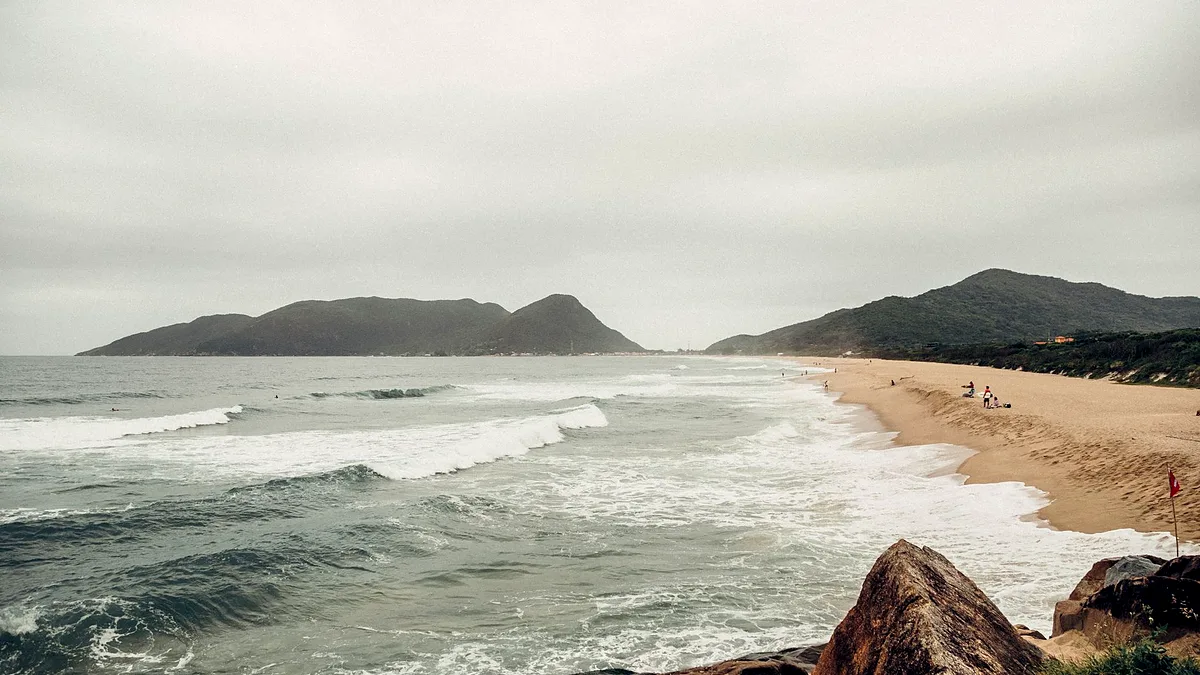

Florianópolis runs on two speeds. There is the summer version — 42 beaches, sunburn, speakers on the sand — and the version locals actually live in: free state galleries in Agronômica, lacemakers working the lagoon, and old social clubs in Centro where the door list is still a handwritten book.
This guide is built around that second version. Expect real addresses, prices in reais, and honest caveats, because several of these places keep odd hours and one or two are not worth your afternoon.
At a Glance: Florianópolis for Art and Quiet Clubs
- Best time to visit: late March to May, or September to November. Same weather, a third of the crowd, and galleries actually have staff on hand.
- Typical daily budget: R$280–650 (~$50–120 USD) per person. Museum entry is mostly free, so your money goes on transport, coffee and one good dinner.
- Getting around: city buses (R$6 / ~$1.10 USD a ride) plus Uber or 99 after dark. A rental car only makes sense for Ribeirão da Ilha or the north beaches.
- Vibe: unhurried and slightly rough around the edges. This is an island of about 500,000 people with a small-town art scene — you will see the same faces twice in a week.
1. Fundação Cultural Badesc and the Centro Gallery Walk
Rua Visconde de Ouro Preto is a short, sloping street behind the main commercial drag, and it holds more contemporary art per metre than anywhere else in Santa Catarina. Badesc occupies a converted bank building with two floors of rotating shows — mostly local names, occasionally someone with a São Paulo following.
Unlimited High-Speed International Travel eSIM
Connect in seconds across 180+ destinations. Instant QR code activation with zero roaming surcharges.

Two blocks away sits the Museu Victor Meirelles, the 19th-century house tied to Brazil's most famous academic painter. It is small, air-conditioned and free. Together they make an easy two-hour loop that costs you nothing but a coffee.
- Neighbourhood: Centro, Rua Visconde de Ouro Preto, 216
- Cost: Free at both
- Best time: Tuesday to Friday, 1pm–5pm; both close Mondays
- Getting there: 8-minute walk from Mercado Público; any Centro bus drops you within four blocks
Insider tip: Badesc opens new shows on Thursday evenings roughly once a month, and that is when the island's curators, ceramics teachers and art students all appear. Check the foundation's Instagram the day before — openings are free, the wine is cheap, and it is the fastest way into the local scene.
2. MASC and MIS at the CIC Complex
The Centro Integrado de Cultura is a large, slightly dated compound in Agronômica that most visitors skip because it is nowhere near a beach. MASC, the state art museum, holds the main collection — colonial religious pieces through to 1970s conceptual work — in a bright, glass-fronted hall.
Next door, the Museu da Imagem e do Som covers photography and film, with a small cinema screening Brazilian documentaries. Both are free, both are quiet on weekday afternoons, and the complex sits a ten-minute walk from the Beira-Mar Norte waterfront.
- Neighbourhood: Agronômica, Av. Governador Irineu Bornhausen, 5600
- Cost: Free entry to both museums
- Best time: Tuesday to Friday, 10am–6pm; closed Mondays
- Getting there: Buses along Beira-Mar Norte, or a 15-minute Uber from Centro for about R$22 (~$4 USD)
Insider tip: The CIC café is grim. Skip it, walk down to Beira-Mar Norte and buy a coconut water from a kiosk on the waterfront instead — half the price and a far better view.
3. Rua das Rendeiras: Lacemakers on the Lagoon
The Lagoa da Conceição is where the island's craft tradition is still alive rather than staged. Along the sand strip at Rua das Rendeiras, women sit outside their houses working bilro lace, bobbins flicking over a padded roll, with patterns handed down through Azorean families since the 1750s.
Watching is free, and pieces start around R$60 (~$11 USD) for a small doily, running to R$400 (~$75 USD) for a table runner that took a fortnight. Ask before photographing. Show real curiosity and several will walk you through how the bobbins work.
- Neighbourhood: Lagoa da Conceição, along Rua das Rendeiras
- Cost: Free to browse; pieces R$60–400 (~$11–75 USD)
- Best time: Mornings, Tuesday to Saturday, before the lagoon wind picks up
- Getting there: Lagoa-bound bus from the Centro terminal, about 40 minutes, R$6 (~$1.10 USD)
Insider tip: The shops on Avenida das Rendeiras resell machine-assisted work at three times the price. Buy from the women working on the sand strip — the money goes straight to the maker and you can ask exactly who made it.
4. Sambaqui and Santo Antônio de Lisboa: Clay and Azorean Art
Head 20 minutes northwest of Centro and the island turns into something much older. Sambaqui is a former fishing village where ceramics studios have moved into colonial houses, selling stoneware, wood-fired bowls and sculpture from the front room of the potter who made them.
Continue to Santo Antônio de Lisboa and the waterfront fills with small galleries showing island landscapes and Azorean work, plus restaurants serving oysters right on the water. It gets busy by 6pm on a Saturday; on a Tuesday morning it is peaceful.
- Neighbourhood: Sambaqui and Santo Antônio de Lisboa, northwest island
- Cost: Free to browse; ceramics R$80–450 (~$15–85 USD)
- Best time: Late afternoon — galleries run until about 6pm, then sunset over the bay
- Getting there: Santo Antônio de Lisboa bus from the Centro terminal, around 30 minutes; or a 25-minute Uber for about R$45 (~$8 USD)
Insider tip: Studios close early and many skip signage entirely. Search for ateliês on Google Maps beforehand and confirm via WhatsApp — potters here answer messages far more reliably than they answer the door.
5. Jurerê Internacional: P12 and Café de la Musique
Jurerê Internacional is the island's polished, moneyed corner, and its beach clubs are the closest thing Florianópolis has to a members' scene. P12 (Parador 12) runs loungers, a pool and a steady house soundtrack; Café de la Musique, the Brazilian outpost of the St-Tropez brand, is a step more formal and considerably more expensive.
Neither is a secret and neither is cheap. In January a front-row lounger at P12 can carry a minimum spend of R$300 (~$55 USD) per person. Off-season on a Wednesday the same spot drops to around R$120 (~$22 USD), with better service and a sunset you can actually see.
- Neighbourhood: Jurerê Internacional, north island
- Cost: Entry usually free; minimum spend from R$120 off-season to R$400+ in January
- Best time: Weekdays, September to November or March to May, arriving around 3pm
- Getting there: Jurerê bus from Centro (about 50 minutes) plus a 15-minute walk, or Uber for roughly R$70 (~$13 USD)
Insider tip: Never book a front-row seat online without checking the minimum spend first — the tiered pricing is often not shown until checkout. Café de la Musique also enforces a dress code: no flip-flops after 6pm at weekends.
6. The Old Private Clubs of Centro
Florianópolis keeps a handful of century-old members' clubs running on invitation and annual dues, among them the Lira Tênis Clube and the Clube de Regatas Aldo Luz down by the waterfront. They are not attractions, and nobody is handing out tours.
They are still worth a walk past for the architecture, and Aldo Luz hosts public sailing regattas through summer where spectators gather on the seawall and grab a beer from the club bar. That is your realistic way in: attend an event, get talking, and an invitation usually follows.
- Neighbourhood: Centro, around Rua Bocaiúva and the Beira-Mar Norte waterfront
- Cost: Free to walk past; regatta days free to watch, beers about R$10 (~$2 USD)
- Best time: Saturday afternoons in summer, from around 3pm
- Getting there: Walking distance from anywhere in Centro
Insider tip: Do not try to talk your way past the front desk — it will not work and it is rude. Stand on the public promenade outside Aldo Luz instead, where the view of the old bridge and the boats is better than the one from inside.
Where to Eat and Drink Nearby
Mercado Público, Centro
The ground-floor arcade of the 1899 market is where office workers, taxi drivers and tourists collide over shrimp pastels and cold beer. Go before noon or after 3pm to get a seat. A pastel de camarão costs about R$22 (~$4 USD) and a chopp around R$10 (~$1.80 USD).
Ostradamus, Ribeirão da Ilha
An hour south, Ribeirão da Ilha farms most of Brazil's oysters, and Ostradamus serves them metres from the tanks. Plastic chairs, tiled floor, superb shellfish. A dozen raw runs R$65–85 (~$12–16 USD); the grilled version with garlic and lime is the local order.
Lindacap, Centro
A Florianópolis institution for Portuguese-Brazilian cooking: salt cod, seafood rice, and a bacalhau à brás that has survived decades on the menu. Local families book it for birthdays, which tells you most of what you need to know. Mains R$65–120 (~$12–22 USD) and portions feed two comfortably.
Getting Around and What It Actually Costs
Buses are cheap and slow. The flat fare is R$6 (~$1.10 USD), payable in cash with exact change or by loading a Cartão Transporte at the Rita Maria terminal or any large stop with a kiosk. The card solves the change problem and allows transfers on some lines.
After dark, use Uber or 99. Both are reliable on the island and consistently cheaper than street taxis — Centro to Lagoa runs roughly R$35–50 (~$6–9 USD).
| Item | Typical cost | USD |
|---|---|---|
| Bus fare, one ride | R$6 | ~$1.10 |
| Uber, Centro to Lagoa | R$35–50 | ~$6–9 |
| Rental car, small hatchback, per day | R$130–200 | ~$24–37 |
| Museum entry, most venues | Free | Free |
| Lunch at a por quilo buffet | R$45–70 | ~$8–13 |
| Sit-down dinner for two | R$180–300 | ~$33–55 |
For cheap food, look for por quilo buffets — load a plate and pay by weight. Centro and Trindade are full of them at lunch, and R$50 (~$9 USD) buys fish, rice, beans and salad.
What to Skip, and a Few Honest Warnings
- Skip the restaurant strip at Lagoa's Centrinho. Water-view tables, mediocre cooking, R$90 mains. Walk five minutes inland for better food at half the price.
- Avoid Joaquina and Ingleses in January. Parking touts, traffic and packed sand. The same beaches in April are empty.
- Gallery hours are a genuine risk. Many small spaces close Mondays and open only 1pm–6pm. Message ahead on WhatsApp; that is simply how things run here.
- Skip the pirate-ship lagoon tours. Around R$80 for 40 minutes of engine noise.
- Bring cash. Small ateliês, beach kiosks and bus fare all depend on it, and card machines fail at convenient moments.
Frequently Asked Questions
Are the art galleries in Florianópolis free?
Yes. MASC, the Museu Victor Meirelles, Fundação Cultural Badesc and the Museu da Imagem e do Som all charge nothing, and the private ateliês in Sambaqui are free to browse. Buy something small if a maker has spent twenty minutes explaining their glazing process.
Do you need to reserve a beach club in Jurerê Internacional?
In January and February, yes — book a week ahead and confirm the minimum spend before paying any deposit. Outside high season you can normally walk into P12 on a weekday afternoon and pick your own lounger.
How many days do you need in Florianópolis?
Four full days works well: two for the lagoon and east coast beaches, one for galleries and Centro, and one for the south around Ribeirão da Ilha. Add a day if you want a beach club afternoon without rushing.
Is Florianópolis safe for tourists?
Generally yes, with ordinary city precautions. Centro is fine in daylight, so stick to busy streets after 10pm, and never leave bags visible in a parked car at trailheads or beach lots.