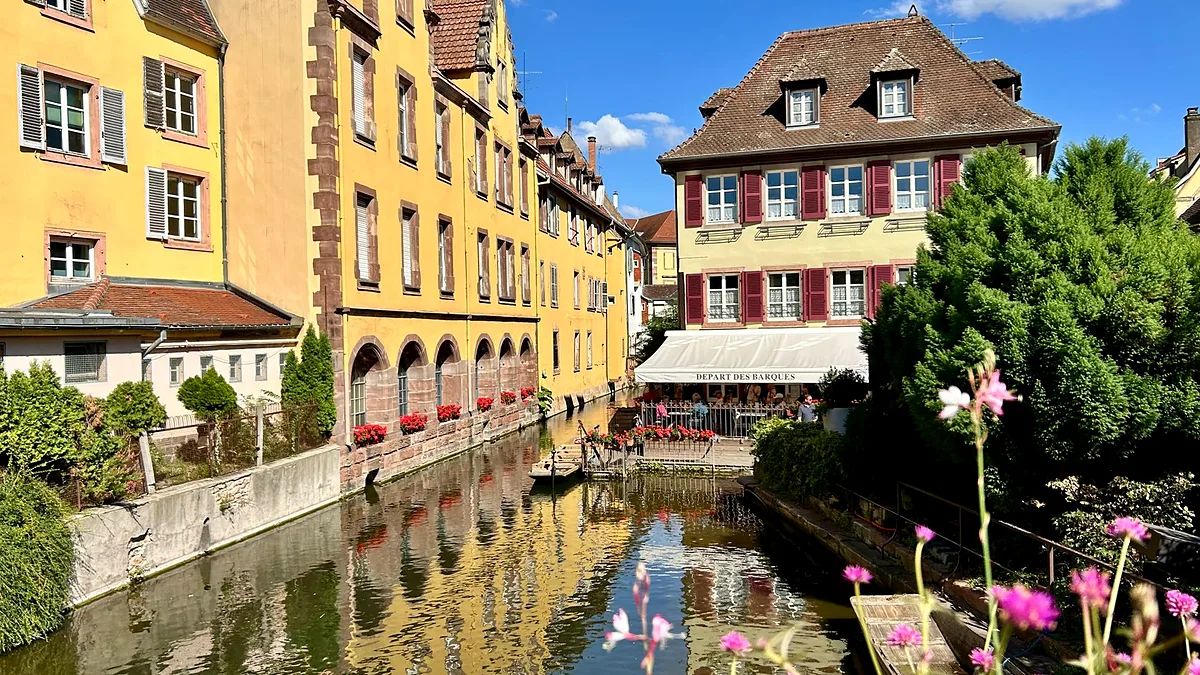

Colmar's old town is roughly four square kilometers, and about 90% of visitors walk the same 800 meters: Grand Rue, Rue des Marchands, then the Pont Saint-Pierre over Petite Venise for the photo. Forty minutes and they're done.
That's a shame, because the interesting stuff sits one street back. There are one-room galleries with no English signage near the covered market, a free medieval reading room on Place des Dominicains, and wine cellars where the door is locked and the tasting happens because you called ahead.
One honest caveat before we start: Colmar has no private members' club in the London or Berlin sense. What it has instead is a tight network of wine societies and appointment-only cellars that work exactly like one. Here's how to get inside.
Unlimited High-Speed International Travel eSIM
Connect in seconds across 180+ destinations. Instant QR code activation with zero roaming surcharges.

Colmar at a Glance
- Best time to visit: Late May to June, and mid-September to late October. Christmas market season (roughly November 25 to December 23) is beautiful and completely packed — book beds three months out.
- Typical daily budget: €90–150 (~$97–162 USD) per person, mid-range. Gallery-and-museum days land nearer €90; cellar-tasting days push past €150.
- Getting around: On foot. The old town is effectively car-free. TRACE city buses serve the edges — single ticket €1.60 (~$1.75), day pass around €4 (~$4.30).
- Vibe: Half working wine town, half open-air museum. Genuinely quiet before 10:00 and after 18:00, once the coach tours pull out.
1. Musée Unterlinden: The Half of the Museum People Walk Past
The Isenheim Altarpiece is the reason this former Dominican convent became a museum, and it earns its 20 minutes. But watch what happens: the crowd clusters in that one room, then heads for the exit sign.
Walk the other direction instead. Downstairs, the excavated medieval foundations and the Gothic cloister are usually empty. Upstairs, the modern wing holds Dubuffet, Soulages and a strong run of post-war French abstraction, and you'll often have it to yourself.
- Neighborhood: Unterlinden, right in the old town center — 1 Rue d'Unterlinden.
- Cost: €15 (~$16 USD) adult; under-18s free. Ask about the combined city-museum ticket if you're doing Bartholdi too.
- Best time: After 15:00. Coach groups hit hardest between 10:00 and 13:00.
- Getting there: A five-minute walk from Place de l'Ancienne Douane. No bus needed.
Insider tip: The benches in the cloister garden are open to ticket holders and almost nobody sits on them. It's the quietest outdoor seat in central Colmar on a hot afternoon.
2. Musée Bartholdi: A Sculptor's Studio on Rue des Marchands
Frédéric Auguste Bartholdi was born in this house in 1834 and later designed the Statue of Liberty. The museum is three creaking floors of plaster models, maquettes and family furniture, and it feels like someone just stepped out of the room.
It takes about 45 minutes, which makes it the perfect counterweight to a morning of crowd-walking. The top floor, where the working models sit under sloped ceilings, is the part worth lingering over.
- Neighborhood: Old town, 30 Rue des Marchands.
- Cost: €6 (~$6.50 USD) adult.
- Best time: Right at opening or after 16:00. Note many Colmar museums close on Tuesdays — check the board outside before you plan the day.
- Getting there: Two minutes from the Maison des Têtes, on the main shopping street.
Insider tip: The little courtyard behind the entrance is free to stand in and gives you the best look at the building's timber framing without paying a cent.
3. The Gallery Row: Rue Berthe Molly and Rue des Clefs
Colmar's commercial art scene is small and stubbornly local. A handful of one-room galleries sit tucked between the covered market and Rue des Clefs, showing Alsatian landscape painters, contemporary printmakers and the occasional ceramics studio.
These are not glamorous spaces. They're the kind of place where the owner is the artist's friend, the price list is handwritten, and opening hours are a suggestion. That's precisely why they're worth an hour.
- Neighborhood: Old town, between Place de l'Ancienne Douane and Rue des Clefs.
- Cost: Free to browse. Prints and small works typically €40–300 (~$43–325 USD).
- Best time: Thursday to Saturday, roughly 14:00–18:30, when most shutters are actually up.
- Getting there: Walk it. Everything is within 400 meters of the covered market.
Insider tip: Sunday and Monday are dead — most galleries stay closed. Don't build your day around them and then blame Colmar. Also bring cash; several spaces don't take cards under €100.
4. Bibliothèque des Dominicains: The Free Room Nobody Tells You About
The city library occupies a Dominican convent founded in the 1230s, and the reading room alone justifies the detour. Vaulted stone, stained glass, long wooden tables, and the sound of nothing but pages.
It's a working library, not a museum, which is exactly why it stays empty of tourists. Entry is free, and you can sit for an hour with a book you don't intend to read.
- Neighborhood: Place des Dominicains, eastern old town.
- Cost: Free.
- Best time: Weekday mornings. Expect reduced hours in July and August, and closure on Sundays and public holidays.
- Getting there: Five-minute walk from the Collégiale Saint-Martin; the door is off the square, not the church.
Insider tip: The adjoining Dominican church hosts the International Colmar Festival in July. If your dates line up, classical concerts in that acoustic cost far less than you'd guess — often €15–30 (~$16–32 USD).
5. Domaine Viticole de la Ville de Colmar: The City's Own Cellar
Colmar owns its own wine estate, which is unusual enough to be worth your afternoon. The domaine farms around 30 hectares of Alsatian varieties — Riesling, Gewurztraminer, Pinot Gris — and runs tastings in a cellar that feels like a municipal secret.
This is the closest thing in town to a private club: low light, barrel rows, and a host who will happily pour you a 2019 you can't buy at home. Book ahead; walk-ins are hit and miss.
- Neighborhood: Just south of the old town, near Rue du Stauffen.
- Cost: A three-glass flight runs €8–12 (~$9–13 USD); a full cellar visit with six wines is around €18–25 (~$20–27 USD).
- Best time: Late afternoon on a weekday. Weekends fill with local groups.
- Getting there: A 12-minute walk from Petite Venise, or one stop on a TRACE bus.
Insider tip: Buy a bottle here rather than at the souvenir shops near the quay — the same Riesling is often €4–6 cheaper and you can carry it home in hand luggage.
6. Koïfhus and Temple Saint-Matthieu: Rooms That Only Open Sometimes
The Koïfhus is Colmar's 1480 customs house, and everyone photographs the outside while missing the upper hall, which opens for exhibitions and city events. When it does, you get bare timber beams and total quiet above a crowded square.
A block away, Temple Saint-Matthieu — a former Franciscan church — doubles as an art and concert venue, with contemporary sculpture set against 13th-century stone. Both are free or nearly free, and both depend entirely on timing.
- Neighborhood: Place de l'Ancienne Douane (Koïfhus) and Rue Saint-Matthieu.
- Cost: Usually free; special exhibitions €5–8 (~$5–9 USD).
- Best time: Check the posters on the doors in the morning — programming is announced locally, not online.
- Getting there: Both are central, within three minutes of each other on foot.
Insider tip: Ask at the Colmar tourist office on Place Unterlinden for the free weekly culture flyer. It lists the small exhibitions that never make it onto travel sites.
7. Where the Actual Private-Club Scene Lives: Kientzheim
For the genuine members-only experience, you have to leave town. Fifteen minutes south, the Confrérie Saint-Étienne occupies a Renaissance château in Kientzheim with a cellar library of more than 50,000 bottles going back decades.
Membership is by sponsorship and, frankly, not something a visitor arranges. The realistic route in is a pre-booked group tasting, which gets you into the cellar for an hour and pours you wines you will not find anywhere else in Alsace.
- Neighborhood: Kientzheim, Route des Vins, roughly 12 km south of Colmar.
- Cost: Group tastings around €20–28 (~$22–30 USD) per person, by reservation only.
- Best time: Weekday slots; weekends book out weeks ahead in autumn.
- Getting there: No direct train. Taxi from Colmar is about €25–30 each way, or take the Route des Vins bus in season and walk in.
Insider tip: If you can't get a slot, don't improvise by knocking on cellar doors. Instead book a tasting at a smaller family domaine in Eguisheim or Turckheim — smaller rooms, more actual conversation, half the price.
Where to Eat and Drink Nearby
Wistub Brenner (1 Rue Turenne, by Petite Venise) is the reliable Alsatian standby. Tarte flambée €10–13 (~$11–14 USD), baeckeoffe around €24 (~$26 USD). It's small, so book or eat at 18:30 sharp.
Le Fer Rouge (52 Grand Rue) has been feeding Colmar since the 1600s and does a proper choucroute for €19–23 (~$21–25 USD). Ask for the upstairs room; it's quieter and away from the door traffic.
La Krutenau, on the corner facing Quai de la Poissonnerie, is where locals go for matelote de poisson at about €24 (~$26 USD). Sit outside at lunch and watch the boat queues you're not standing in.
Practical Logistics and Budget Tips
- Walk everything. Cobblestones are the real obstacle — bring flat soles. The little tourist train is a waste of €8 (~$9 USD) in a town this size.
- Buy a TRACE day pass only if you're heading to the wine estate or the station more than twice. Otherwise pay per ride at €1.60.
- Eat lunch, not dinner. Many kitchens close between 14:00 and 19:00, and lunch menus are €6–9 cheaper for the same food.
- Check closure days. Tuesday hits several museums; Sunday and Monday hit the galleries. Stack your itinerary accordingly.
- Skip: the €8 Petite Venise boat rides on a weekend (45-minute queue, 20-minute ride) and any "traditional Alsatian" restaurant with photos on the menu.
- Cash: Carry €50–80. Small galleries, some winstubs and market stalls are card-shy.
Frequently Asked Questions
Does Colmar have private members' clubs?
Not in the classic sense — there's no members' club you can walk into off the street. The closest equivalents are the wine societies and appointment-only cellars, such as the Confrérie Saint-Étienne in nearby Kientzheim, which you access through a booked tasting.
Are Colmar's art galleries free to enter?
Yes, browsing is free at nearly all the small galleries near Rue Berthe Molly and Rue des Clefs. You only pay for work, and many spaces are closed Sunday and Monday and open just Thursday to Saturday afternoons.
When is Petite Venise quiet?
Before 9:30 and after 18:30, when the day-trippers have left and the light is better anyway. Midweek in May, June or October is far calmer than any weekend in December.
How long should I give the Musée Unterlinden?
Two hours is right if you want the Isenheim Altarpiece plus the modern wing and cloister. If you're short on time, go after 15:00 and head straight for the upper galleries, which stay almost empty all day.