
The Quick Verdict
Colmar is the closest thing Europe has to St. Barts without an ocean: a small, wealthy, immaculately kept French town where the food is serious, the wine is local, and nobody is in a hurry. You trade white sand for cobblestones and rosé for Riesling, but the daily rhythm — long lunch, slow afternoon, excellent dinner — is remarkably similar. The difference is that Colmar costs about a quarter of what St. Barts does.
What you sacrifice is real, though. There's no beach, no sea breeze, and no winter sun. St. Barts sits around 28°C in February; Colmar sits at 3°C. If your holiday is built around swimming, snorkelling, and a sun lounger, no amount of half-timbered charm will fix that. If it's built around good taste, good food, and wandering, Colmar wins on value by a mile.
Side-by-Side Comparison Scorecard
| Feature | St. Barts | Colmar |
|---|---|---|
| Average Daily Cost (Stay + Meals) | €900–1,400 (~$975–1,510) per couple, high season | €230–330 (~$250–355) per couple, all-in |
| Atmosphere & Aesthetic | Barefoot French-Caribbean luxury: white villas, superyachts in Gustavia, beach clubs | Half-timbered old town, canal quarter, wine cellars — quiet, tidy, understated |
| Crowd Density & Seasonality | Peak December to April; New Year's week is the crush. September–October is quiet but half-closed | Coach crowds 10am–4pm; heavy in December for the Christmas markets; calm before 9am and after 7pm |
| Flight & Transit Accessibility | Fly to St. Maarten or San Juan, then a 15-minute hop or a ferry; no direct long-haul | TGV from Paris in 2h20; 45 minutes from Basel-Mulhouse airport; the old town is fully walkable |
| Best For | Beach days, guaranteed winter sun, celebration trips, sailing | Food and wine, architecture, slow weekends, value-minded luxury |
Scenery & Atmosphere: How Similar Are They Really?
St. Barts is 21 square kilometres of dry, hilly terrain ringed by small coves and beaches — Saline, Gouverneur, Colombier, and Shell Beach among the best known. Gustavia's harbour holds superyachts, and the villages of Lorient, St-Jean, and Grand Cul-de-Sac are low white villas with tin roofs and wooden gingerbread trim. Nothing is tall. Nothing is loud. The whole island is styled to look effortless.
Unlimited High-Speed International Travel eSIM
Connect in seconds across 180+ destinations. Instant QR code activation with zero roaming surcharges.

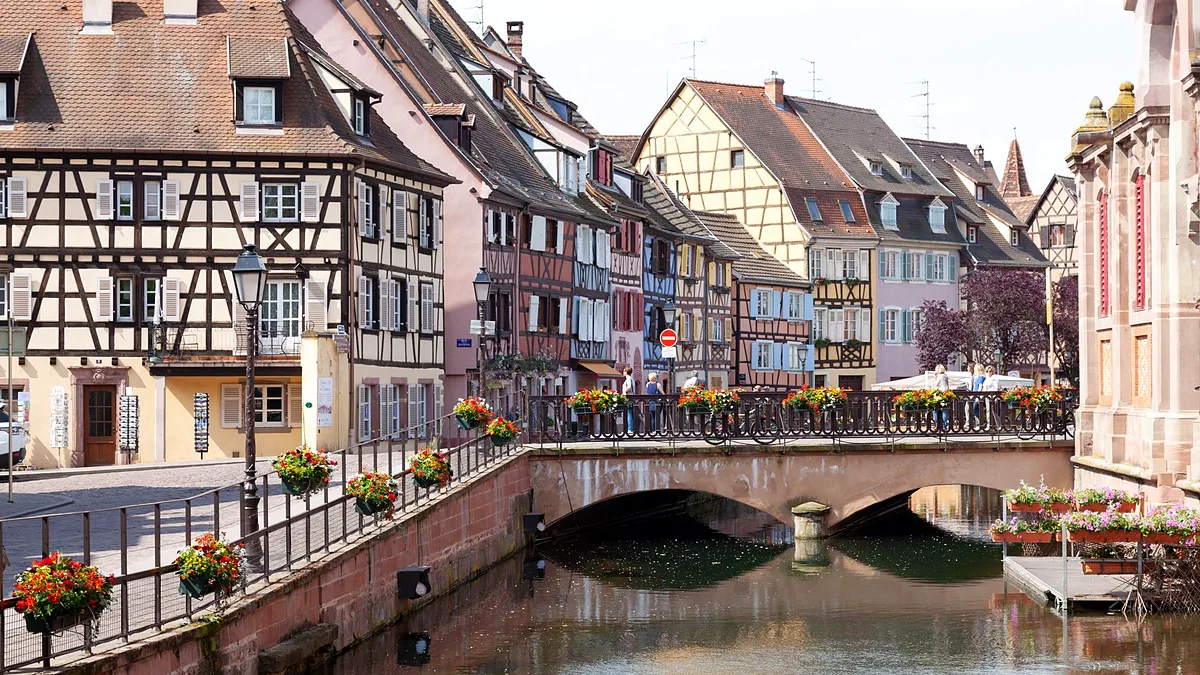
Colmar's old town is a compact grid of half-timbered houses painted ochre, mint, salmon, and mustard, with flower boxes and wooden shutters. The Petite Venise quarter along the Lauch river is the postcard shot. It's roughly 200 metres long, not a canal network, so don't arrive expecting Venice.
The real similarity is upkeep. Both places are fastidious — no peeling paint, no graffiti, no chain stores in the historic core. Both feel expensive in the way quiet places do: nothing shouts, everything is maintained.
Where they diverge is scale. St. Barts is a driving island; you need a car to reach Saline or Gouverneur, and the roads climb. Colmar fits inside a 25-minute walk, which changes the whole experience. You stop navigating and start noticing.
The Wallet Test: Real Cost Breakdown
These are realistic high-season figures, converted at roughly €1 = $1.08.
| Cost Item | St. Barts | Colmar |
|---|---|---|
| Mid-range double room, high season | €450–700 / ~$490–760 | €130–200 / ~$140–215 |
| Casual lunch (one course + drink) | €40–55 / ~$43–60 | €15–22 / ~$16–24 |
| Dinner for two with wine | €180–280 / ~$195–305 | €80–120 / ~$87–130 |
| Cocktail or glass of local wine | €20–26 / ~$22–28 | €5–8 / ~$5–9 |
| Best-value activity | Free — hike to Colombier Beach or swim at Saline | Free — bike the Route des Vins; Unterlinden Museum €13 |
| Getting around | Rental car €80–110/day; no rideshare and taxis are costly | On foot; bike rental €12–18/day; train to Strasbourg €10–14 |
Two things stand out. First, the accommodation gap is brutal: a mid-range double in Colmar costs less than one dinner for two in St. Barts. Second, Colmar's best experiences are nearly free — the wine route is a bike path, the Petite Venise walk costs nothing, and the Unterlinden is €13.
St. Barts has free beaches, but everything attached to them carries a premium: parking, loungers, lunch, a bottle of water. Budget an extra €150 a day without thinking hard about it.
Crowds, Authenticity, and Tourist Footprint
Colmar has about 70,000 residents and pulls in well over a million visitors a year, most of them day-trippers arriving by coach between 10am and 4pm. That's the window to avoid. Walk Petite Venise at 8:30am and you'll have the canals almost to yourself; try at 1pm in July and you'll queue for a photo.
December is the pressure point. Colmar runs five Christmas markets from late November to late December, and weekend evenings are genuinely packed. Go midweek, stay overnight — the coaches leave at 6pm and the town changes character — and book restaurants two weeks ahead.
St. Barts' crowd problem is different: it's money, not volume. High season runs December to April, New Year's week is the peak, and room rates triple. Cruise ships drop up to 2,000 passengers into Gustavia for a few hours at a time. September and October are cheap because it's hurricane season and a chunk of the restaurant scene closes.
Honest verdict: Colmar has more raw footfall, St. Barts has more attitude. Neither is a secret. Both reward early mornings.
How to Experience the Best of Colmar
Where to Stay
Stay inside the old town ring if you can. The streets around Grand Rue, Rue des Marchands, and Quai de la Poissonnerie put you two minutes from everything and cost €160–260 a night for a good three- or four-star.
Budget option: the blocks near the train station are 12 minutes' walk from Petite Venise and 30% cheaper, but the neighbourhood is bland. For wine-country atmosphere, base in Eguisheim or Turckheim instead — both are a short drive or a 20-minute bike ride away.
What to Do
- Unterlinden Museum — €13 / ~$14, and home to the Isenheim Altarpiece, which justifies the trip on its own. Closed Tuesdays.
- Bike the Route des Vins — €12–18 a day from any rental shop in town. The flat run to Eguisheim is 5 km; Turckheim is 6 km.
- Wine tasting — cellar visits at Domaine Viticole de la Ville de Colmar start around €10 for a flight of five.
- Saint-Martin church — free entry, and the 14th-century Gothic choir beats most cathedrals you'd pay to enter.
- Day trips — Strasbourg is 30 minutes by train (€10–14), Basel is 45 minutes by car, and the German border is 15 minutes away.
What to Eat
Start with tarte flambée (€9–14), a paper-thin flatbread with crème fraîche, bacon, and onion. Then baeckeoffe — a slow-cooked mutton, beef, and pork casserole in Riesling — at €20–26, or choucroute garnie if you want the full Alsatian plate.
For a splurge, JY's holds two Michelin stars and runs a tasting menu near €150; L'Atelier du Peintre has one star and a €55 lunch. For something unpretentious, Wistub Brenner on Quai de la Poissonnerie serves solid local plates in a 40-seat room — book ahead.
Who Should Still Choose St. Barts?
If sun is the point of the trip, book St. Barts. Colmar in January is grey, wet, and around 3°C, and no amount of mulled wine turns that into a beach holiday. Anyone travelling with kids who need water, or who measures a holiday in swims, should skip the comparison and pay for the island.
St. Barts also wins on genuine exclusivity. It has roughly 10,000 residents, no direct long-haul flights, and no mass-market hotels. Colmar, by contrast, sits on every Rhine river-cruise itinerary. If you want to be somewhere most people can't easily reach, the island delivers that in a way Alsace can't.
And if you're marking an occasion — a honeymoon, a milestone birthday — the villa-and-superyacht scene in Gustavia does something Colmar doesn't attempt. That's a fair reason to spend four times more.
Frequently Asked Questions
Is Colmar actually cheaper than St. Barts?
Yes, dramatically — roughly 70–75% cheaper on a like-for-like day. A comfortable mid-range day for two in Colmar runs €230–330 (~$250–355) including a good room, two restaurant meals, and wine. The same standard in St. Barts lands at €900–1,400 (~$975–1,510).
Does Colmar feel luxurious, or just pretty?
Luxurious, if your definition is good food, good wine, and beautifully kept streets. Colmar has a five-star hotel (Le Maréchal), serious Michelin kitchens, and a wine culture that goes back centuries. It does not have a spa-and-pool resort scene, and it does not have a sea.
When is the best time to visit Colmar instead of the Caribbean?
May, June, September, and early October. Temperatures sit at 18–26°C, the vineyards are working, and the coach crowds thin out. Early December is beautiful for the Christmas markets, but go midweek and stay overnight.
Can you do Colmar without a car?
Yes. The old town is fully walkable, the train station connects to Strasbourg, Basel, and Paris (TGV direct, about 2h20), and bike rentals cover the wine route. Only hire a car if you're staying outside town or want to reach the smaller villages on your own schedule.