
Quick Route Overview
This four-day Colmar plan is for travelers who would rather see six things properly than sixteen badly. The pace is deliberately unhurried: one museum a day at most, a real sit-down lunch, and evenings left open for wine and wandering. If you get restless without a checklist, you will find Day 2 too quiet.
The route works because Colmar's old town is only about 1.5 km across. You can walk every sight in this itinerary without ever calling a taxi. Days 1, 2 and 4 stay inside the city; Day 3 heads into the vineyard villages by regional bus. All of it assumes you sleep in the old town, which saves you a 15-minute walk from the station every single morning.
- Duration: 4 days / 3 nights
- Best season: Mid-May to late June, or September to mid-October (mild weather, thinner crowds)
- Where to base yourself: The Old Town, between Place de l'Ancienne Douane and the Quai de la Poissonnerie — central, quiet at night, and 5 minutes from everything
- Getting around: On foot, plus the Trace city bus for arrival and one regional bus for the wine villages
Day 1: Land Softly in the Old Town
Morning
From the Gare de Colmar, walk 12 minutes down Avenue de la République and you are already inside the old town. Drop your bags at the hotel (most hold them before check-in) and start with the block around Rue des Marchands. The Maison Pfister, with its painted wooden gallery, sits at number 11, and the Maison des Têtes is two streets over.
Unlimited High-Speed International Travel eSIM
Connect in seconds across 180+ destinations. Instant QR code activation with zero roaming surcharges.

Breakfast is a coffee and a kougelhopf at Pâtisserie Gilg on Rue des Marchands — roughly €6 / $6.50 USD. Then step into the Collégiale Saint-Martin, a yellow-stone church that feels bigger inside than its facade suggests. Entry is free and it takes 15 minutes.
Afternoon
Lunch at Wistub Brenner on Rue Turenne: a tarte flambée and a glass of Riesling runs €16–20 / $17–22 USD. Portions are generous, so one between two works if you have a big dinner planned.
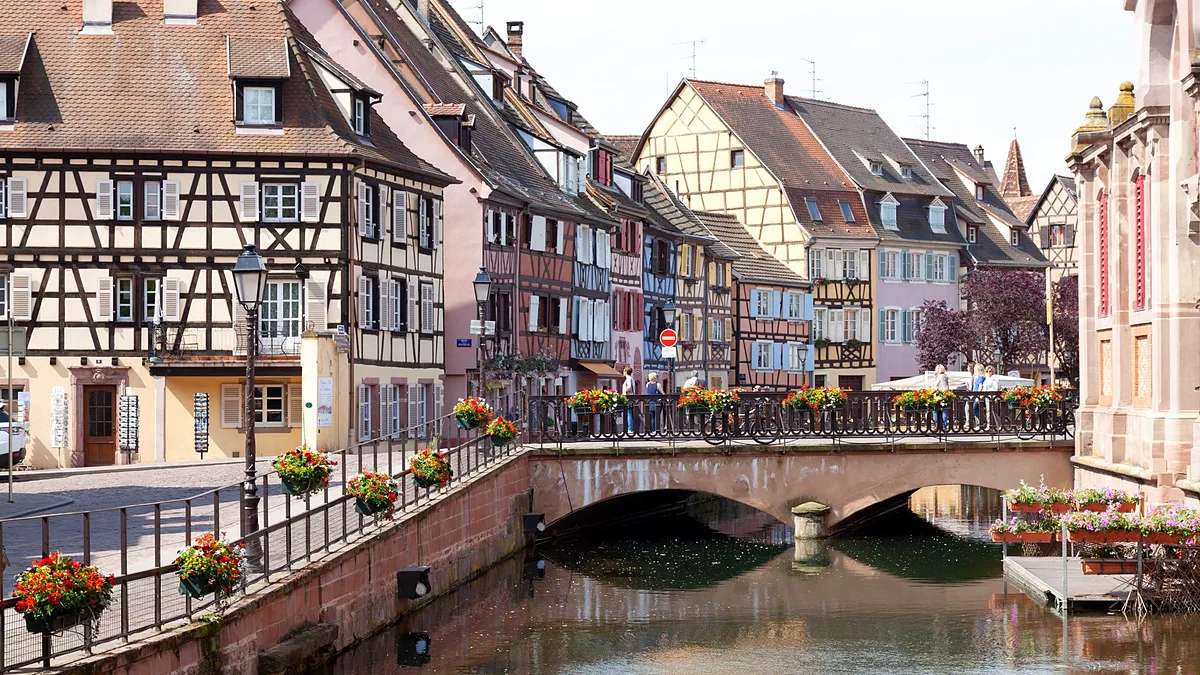
After eating, walk south to the Quai de la Poissonnerie — the tanners' and fishermen's quarter locals call Little Venice. Take the 25-minute boat ride from near the Pont Saint-Pierre (€8 / $8.70 USD, cash is easier). It is a bit touristy, but seeing the half-timbered houses from the water level is worth the twenty minutes.
Evening
Skip the sunset crowds on the bridge and instead get dinner at Wistub de la Petite Venise on Rue de la Poissonnerie — expect €28–35 / $30–38 USD per person with wine. Afterwards, walk five minutes to the Domaine Viticole de la Ville de Colmar tasting room for a glass of Crémant d'Alsace (€5 / $5.40 USD) before closing.
Route efficiency tip: Everything on Day 1 sits inside a 600-metre loop between Rue des Marchands and the Quai de la Poissonnerie. Do not wander north to the station area or the toy museum today — you will just be doubling back tomorrow.
Day 2: Art, Altarpieces and Alsace Wine
Morning
Give the Musée Unterlinden two full hours. It opens at 10am and is closed on Tuesdays; entry is €13 / $14 USD. The Isenheim Altarpiece alone justifies the ticket, and the former convent halls stay cool even in August heat. Book a timed slot online in summer and during the Christmas market period.
Afterwards, take coffee at a café on Rue des Unterlinden rather than the museum café — it is cheaper and you get a table with locals.
Afternoon
Lunch at Le Fer Rouge on Grand Rue (€22–28 / $24–30 USD for a main) or, for something lighter, grab a pretzel and a salad from the covered market. Then spend 45 minutes at the Musée Bartholdi on Rue des Marchands (€6 / $6.50 USD, also closed Tuesdays) — it is the sculptor's birthplace and a genuinely odd little house.
Finish the afternoon at the Dominican Church, five minutes away, to see Martin Schongauer's Madonna of the Rose Bush. Entry costs about €2 / $2.20 USD and the side chapels are worth sitting in.
Evening
Walk to the Parc du Champ de Mars for the soft evening light — it is flat, green and mostly locals on benches. Dinner is where you choose to spend: La Maison des Têtes on Rue des Têtes for a special-occasion tasting menu (from about €95 / $103 USD), or L'Atelier du Peintre for one Michelin-starred cooking at €110+ / $119 USD. Book either at least three days ahead.
For a cheaper night, tarte flambée and beer at a winstub will cost under €25 / $27 USD. End with a slow lap of the illuminated old town.
Route efficiency tip: Unterlinden, the Bartholdi house and the Dominican Church all sit within 400 metres of each other along the northern arc of the old town. Do them in one sweep and you will never recross the centre.
Day 3: Wine Villages by Bus
Morning
Catch the Trace regional bus from the Gare de Colmar to Eguisheim — about 20 minutes and €1.80 / $2 USD per ticket. Buses run roughly hourly, but the last return is often around 6–7pm, so check the Trace app the night before. Eguisheim is a circular village of concentric lanes; walk the outer ring first, then cut inward to the Château Saint-Léon.
Coffee in the main square costs €3–4 / $3.30–4.30 USD. Storks nest on chimneys from March to August, and nobody minds you stopping to stare.
Afternoon
Lunch in Eguisheim runs €18–26 / $20–28 USD for a plate of baeckeoffe or choucroute. If you want to spend big, the two-starred Chambard serves a lunch that is genuinely worth the money — budget €120+ / $130 USD and reserve well ahead.
Continue by bus to Kaysersberg (roughly 25 minutes) for the afternoon. The ruined castle above town is a 25-minute uphill walk, the river runs right through the middle, and wine tastings in family cellars cost €5–10 / $5.40–11 USD for four or five pours.
Evening
Return to Colmar in time for an unfussy dinner near the station quarter or your hotel — a flammekueche and a glass of Gewürztraminer for around €20 / $22 USD. Sleep early; Day 4 starts with the market.
Route efficiency tip: Do not try to add Riquewihr on the same day. It is doable, but you will spend the afternoon watching the clock instead of the vineyards. Two villages is the right number.
Day 4: Markets, the Tanners' Quarter and a Slow Goodbye
Morning
The Marché Couvert on Rue des Écoles is open Monday to Saturday and closed on Sundays — arrive by 9:30am for the best cheese, charcuterie and Munster. Expect €10–15 / $11–16 USD for a breakfast picnic. It is a working market, not a photo set, so keep moving and let the vendors serve their regulars.
Then take a 10-minute walk to the Musée du Jouet on Rue Vauban (€7 / $7.60 USD, open daily). It is small, a bit dated, and quietly lovely if you have any nostalgia for tin toys.
Afternoon
Spend the middle of the day in the Tanners' Quarter — the Rue des Tanneurs and the Quai de la Poissonnerie — now that the tour groups have thinned out. Lunch back at the covered market or at a small winstub, €15–22 / $16–24 USD.
If you still have energy, the little tourist train departing near the Koïfhus costs €8 / $8.70 USD and covers the outer town. Honestly, it is skippable — you have already walked more interesting streets on foot.
Evening
Do your final walk along the Lauch at dusk, then eat wherever you liked best on Day 1. A last glass of Riesling on a terrace costs €5–7 / $5.40–7.60 USD. If you are catching an evening train, allow 15 minutes to walk to the station.
Route efficiency tip: The market, the toy museum and the Tanners' Quarter form a straight line heading south-east. Leave your bags at the hotel, do the line once, and collect them on the way to the station.
Getting Around Colmar
The old town is pedestrianised and flat — nearly every sight in this itinerary is under 20 minutes on foot, and taxis are genuinely scarce. Use the Trace bus network for the station and the villages: single tickets are about €1.60–1.80 / $1.70–2 USD, and a day pass costs around €4.30 / $4.70 USD. Buy on the app or from the driver with coins.
Bike rental costs about €15–18 / $16–19 USD per day and unlocks the flat vineyard roads without waiting for buses. A car is more trouble than it is worth inside the city — park at the Lacarre car park under the Champ de Mars and leave it there. The old town is well lit and feels safe at night, though the area around the station is quieter after 10pm.
Estimated Daily Budget Breakdown
| Travel Style | Accommodation | Food & Drink | Transit & Sights | Total / Day |
|---|---|---|---|---|
| Budget Backpacker | €45 / $49 USD | €30 / $33 USD | €12 / $13 USD | ~€87 / ~$94 USD |
| Comfortable Mid-Range | €130 / $141 USD | €65 / $71 USD | €25 / $27 USD | ~€220 / ~$239 USD |
| Boutique Splurge | €280 / $304 USD | €140 / $152 USD | €60 / $65 USD | ~€480 / ~$521 USD |
Prices assume two people sharing a room and exclude the small city tax (taxe de séjour), usually €1–2.50 per person per night.
Frequently Asked Questions
Do I need to book museums and restaurants in advance?
In April, May, September and October, only dinner on a weekend needs advance booking — two or three days is enough. In July, August and all of December, book Unterlinden tickets online and reserve restaurants a week out. Christmas market weekends require weeks of lead time.
Is Colmar walkable, or do I need a car?
Fully walkable, and a car is a liability in the old town. If you want to explore the Route des Vins beyond the bus network, hire a car for one day and return it the same evening.
When is the Christmas market, and should I come then?
Roughly late November to the days before Christmas, spread across five or six squares including Place des Dominicains and the Koïfhus. It is beautiful and genuinely crowded — visit midweek, sleep on a Tuesday or Wednesday, and expect hotel rates to double.
Where can I store luggage on arrival or departure day?
The Gare de Colmar has a small left-luggage facility, but lockers fill quickly in summer. Most old-town hotels hold bags free of charge before check-in and after checkout, so ask first.