
Quick Route Overview
This two-day route is built for slow travel in the colder months, when Florianópolis swaps beach towels for wool sweaters and the Baía Norte turns grey and glassy. You get one full day on the north bay around Santo Antônio de Lisboa and one day in the old Centro, with long lunches, a colonial fort, an oyster shack and a walk across a 1926 bridge. No 6am starts, no beach-hopping marathon, no more than three Ubers a day.
Winter here (June to September) means 12–20°C afternoons, steady wind off the Atlantic and the occasional two-day rain front. Keep the outdoor blocks flexible and hold the Centro day in reserve if a storm parks itself over the island. Rates drop 30–40% against January, the streets are quiet, and the oyster harvest peaks between May and August — a fair trade for a little drizzle.
- Duration: 2 days / 2 nights
- Best season: May to August (oyster season, low rates, mild days)
- Recommended base: Santo Antônio de Lisboa — small pousadas with bay views, 20–30 minutes from the Centro
- Transit method: Uber/99 as the backbone plus Insular city buses; there is no metro on the island
- Daily spend: R$300 (~$55) to R$2,800 (~$510) depending on style
Day 1: Oyster Shacks and Azorean Lanes on the North Bay
Morning
Start late, around 8:30, with coffee on Rua da Praia in Santo Antônio de Lisboa. Pick any small pastelaria facing the water and order a café com leite, a pão de queijo and a slice of bolo de milho — R$25–35 (~$5–6) for the lot.
Unlimited High-Speed International Travel eSIM
Connect in seconds across 180+ destinations. Instant QR code activation with zero roaming surcharges.

Then walk the praça to the Igreja de Nossa Senhora das Necessidades, a whitewashed 18th-century church from the Azorean settlement period. The interior opens mostly around Mass times, so don't count on getting inside; the churchyard view over the bay is the real reason to come.
From there, follow the waterfront lane north toward Sambaqui. It's flat, partly sidewalked and takes about 25 minutes on foot, past painted Azorean houses, fishing boats pulled up on the sand and fig trees swallowing old walls.
Afternoon
Lunch is the main event: oysters pulled from the water you just walked beside. Restaurante Anízio is the well-known address on Rua da Praia — a dozen native oysters runs R$90–130 (~$17–24), a whole grilled fish for two R$140–180, and the smaller family-run marisqueiras next door do the same thing for a bit less.
Many of these kitchens close on Mondays and Tuesdays, so check before you build the day around one. If everything's shut, the kiosks along the Sambaqui waterfront sell pastel de camarão for R$18–25 and grilled fish plates for R$45–60.
After lunch, take an Uber 15–20 minutes north (R$30–40) to the Fortaleza de São José da Ponta Grossa, a 1739 stone fort above the beach at Jurerê. Entry is around R$10 (~$2), it's closed Mondays, and the ramparts look straight out at the open Atlantic.
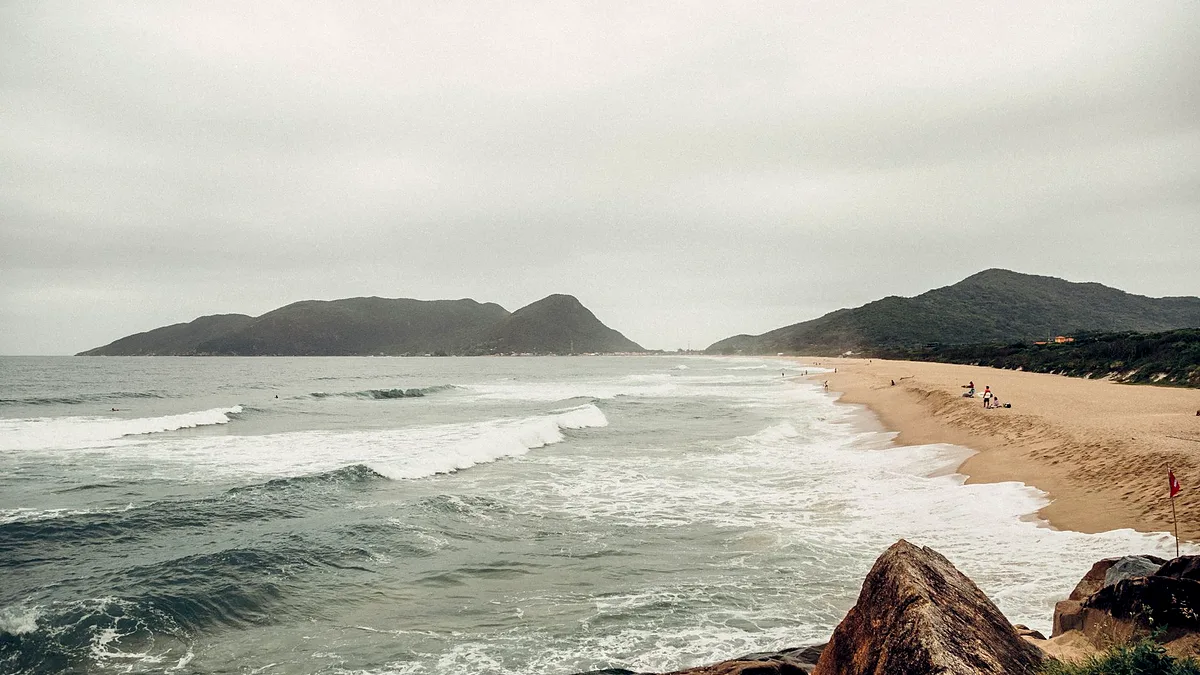
For your scenic pause, drop down to Praia do Forte or walk the quieter stretch of sand at Sambaqui as the light softens. Both are calm-water beaches in winter — good for shell hunting, not for swimming.
Evening
Head back to Santo Antônio for sunset, which lands around 5:30–6pm in June and July. The sun drops behind the mainland hills across the Baía Norte, the church silhouette goes dark against an orange sky, and the fishing boats start coming in. It's the best free show on this side of the island.
Dinner back on Rua da Praia — Anízio again if you liked it, or one of the smaller marisqueiras — runs R$150–220 (~$27–40) per person with a bottle of Santa Catarina white. For something cheaper, Cacupé has pizza and burger spots at R$60–90 per person.
Finish with a beer at a waterfront kiosk. In winter most places wind down by 11pm, so this is a genuinely early night — which is the point.
Route efficiency tip: Day 1 hugs a single 8-km stretch of the Baía Norte coast — Cacupé, Sambaqui, Santo Antônio de Lisboa, then Jurerê. Pick one direction and stop in order. Backtracking here costs 20 minutes and R$35 in Uber every time.
Day 2: Public Market, Old Bridge and the Centro at Walking Pace
Morning
Take an Uber to the Centro (25–35 minutes, R$40–55) or the Insular bus from Santo Antônio to TICEN (around 40 minutes, R$7 / ~$1.30). Start at the Mercado Público at 9:30, before the lunch crowd fills the aisles.
Grab coffee and a pastel de camarão (R$15–20) from one of the old boxes inside, then walk a lap of the fish market side, where the morning catch is still being unpacked. Weekdays are calm; Saturdays are loud and fun but crowded.
From the market it's a five-minute walk to Largo da Alfândega, then Praça XV and the Catedral Metropolitana. The cathedral is free to enter and open daily — ten minutes inside is enough.
Afternoon
Your history stop is the Palácio Cruz e Sousa on Praça XV, home of the Museu Histórico de Santa Catarina. It's a pink colonial-era palace with a modest R$5 entry, closed Mondays and open roughly Tuesday to Friday, 10am–6pm.
For lunch, join the office crowd at a por-quilo buffet — R$60–75 per kilo (~$11–14) for rice, beans, grilled fish and salad. A boteco plate near the market costs R$50–70 if you'd rather sit down and order.
Then walk the Ponte Hercílio Luz. There's no metro, so take a short Uber (R$15–20) to the mainland-side entrance near the Rita Maria bus terminal, walk the 1.2 km pedestrian lane across the 1926 steel bridge, and loop back. It's free, takes 30–40 minutes each way, and closes in high wind or heavy rain.
Prefer to skip the city? Swap this afternoon for Ribeirão da Ilha, 40 minutes south by car, where the colonial street faces oyster farms and Ostradamus serves the island's most polished seafood lunch.
Evening
For sunset, ride up to the Miradouro do Morro da Cruz (R$25 by Uber from Praça XV), a free viewpoint that takes in both bays and the whole island spine. Go before dark — it's a residential hill road and not a place to walk alone at night.
If the weather is foul, the Beira-Mar Norte waterfront or Praça XV gives you a low-effort substitute without another ride.
Dinner near the Mercado Público, where the upstairs restaurants serve seafood plates at R$90–140 per person. Then a nightcap on Largo da Alfândega or Rua Trajano. The Centro empties out by 10pm on weeknights, so keep it short and take an Uber home.
Route efficiency tip: The Centro sights — Mercado Público, Praça XV, the palace, the cathedral — all sit inside a 1.5-km square and take six minutes to walk between. Do them as one loop, then take a single ride to the bridge or the morro. Don't shuttle back and forth.
Getting Around Florianópolis
There's no metro or train on the island, so your options are buses, rideshare and rental cars. Uber and 99 are cheap and reliable across the Centro and north bay, with most trips landing between R$20 and R$55.
The Insular bus network charges a flat R$7 (~$1.30) per ride, paid in cash to the driver. The two terminals that matter are TICEN in the Centro and TICAN in the north; from either you can reach Santo Antônio de Lisboa, Jurerê and Lagoa da Conceição.
Skip the rental car for two days — parking in the Centro is a headache and the math rarely works. Rent one only if you're adding Lagoa, Campeche and the south of the island. Sidewalks are uneven in the old town, and the Centro gets quiet after 10pm, so use rideshare at night.
Estimated Daily Budget Breakdown
| Travel Style | Accommodation | Food & Drink | Transit & Sights | Total / Day |
|---|---|---|---|---|
| Budget Backpacker | R$120–180 (~$22–33) hostel dorm | R$120 (~$22) kiosks and buffets | R$60 (~$11) buses, one fort ticket | R$300–360 (~$55–65) |
| Comfortable Mid-Range | R$450–600 (~$82–109) pousada double | R$280 (~$51) oyster lunch, dinner, wine | R$120 (~$22) Ubers and entries | R$850–1,000 (~$155–180) |
| Boutique Splurge | R$1,200–2,000 (~$218–364) bay-view suite | R$600 (~$109) top-end seafood and wine | R$250 (~$45) private transfers | R$2,000–2,800 (~$365–510) |
Trip Planning Essentials
- Pack a windproof shell and a warm layer — the bay wind is the thing that surprises people, not the temperature.
- Carry some cash for kiosks, fort tickets and small marisqueiras.
- Book Friday and Saturday dinners ahead; weekdays you can usually walk in.
- Check restaurant Instagram pages the day you go — winter closures and Monday/Tuesday shutdowns are common.
Frequently Asked Questions
Do I need to book restaurants in advance in winter?
For weekend dinners at Anízio and any of the Santo Antônio marisqueiras, yes — send a message a day or two ahead. On weekdays in June and August you can generally walk in, and lunch is almost always first-come.
Is it worth renting a car for two days?
No. With this route you're covering maybe 25 km a day, and rideshare works out cheaper than a rental (R$120–180 daily) plus parking. Rent a car only if you're staying four days or more and want the south beaches.
What is the weather really like in July and August?
Expect 12–20°C days, strong wind and rain fronts that last a day or two. Ocean temperature sits near 17°C, so swimming is for the brave. The upside: empty beaches, lower rates and the best oysters of the year.
Where can I leave luggage if I arrive before check-in?
Most pousadas will hold bags for free once you've booked. Otherwise the Rita Maria bus terminal has a paid guarda-volumes at roughly R$15–25 (~$3–5) per bag per day, which is handy if you're catching an evening bus out.